Old Jail

Why it's listed
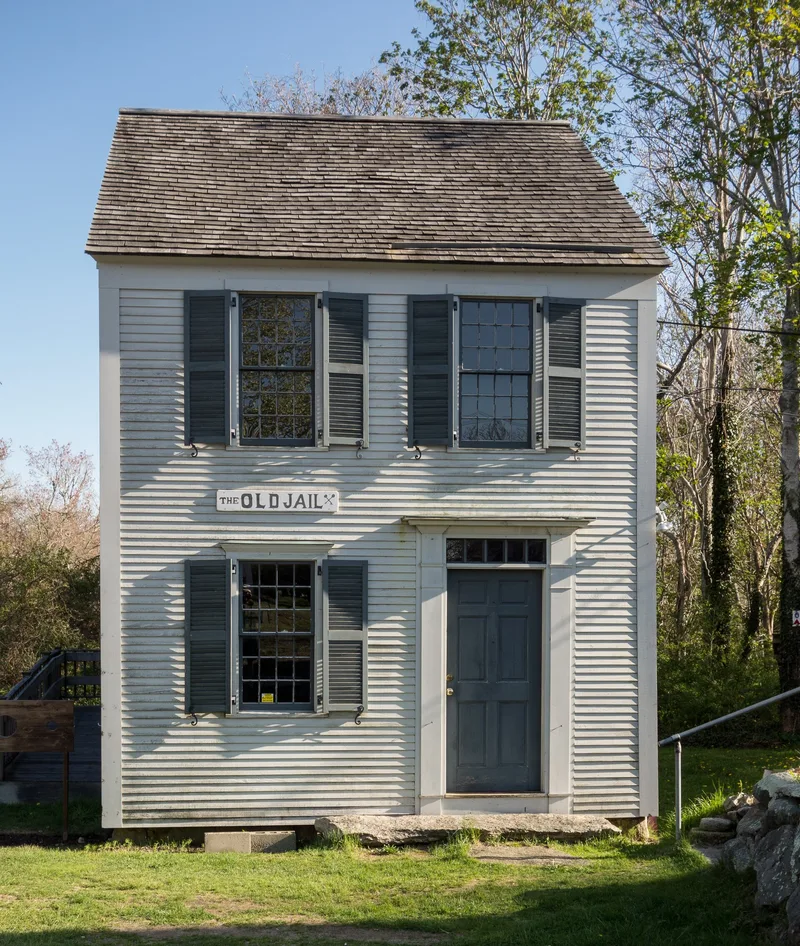
Built between about 1690 and 1700 in Barnstable Village, this wooden jail served Barnstable County and is regarded as the earliest known jail of Plymouth Colony. It is also one of the oldest wooden structures of its kind in New England. The original building was a two-story, timber-framed structure on a stone foundation, with gunstock posts, four-inch vertical planking and layers of horizontal sheathing. In the 18th century a two-story, five-bay addition made it L-shaped, and the eastern two bays of that addition were later removed. By 1702 prisoners were held there awaiting trial at the court sessions in Barnstable. Much original material survives inside, including walls scratched by prisoners with ship and schooner designs and broad arrow marks. At the time of listing the building was owned by the Town of Barnstable, unoccupied and in fair condition. It was later moved with a federal grant to Route 6A, next to the Trayser Museum, to ensure its preservation.
Significance in brief: It is described as the earliest known jail of Plymouth Colony and one of the oldest wooden structures of its kind in New England. Its heavy oak post-and-plank construction is typical of late 17th-century colonial building. Prisoners' scratched ship drawings and broad arrow marks survive on the interior walls.
Machine-generated summary. This summary was generated by a language model from the official nomination document and has not been reviewed line by line by an editor. It may contain errors. Check the source document before relying on any detail. Source: nomination document (PDF) · National Archives catalog entry. NRHP reference 71000078, listed July 2, 1971. Summary generated October 2026 (model claude-sonnet-5-5, prompt v1.0-2026-10-29, confidence medium).
Key facts
| Address | Route 6A, Barnstable |
|---|---|
| County | Barnstable County |
| Listed | July 2, 1971 |
| Reference number | 71000078 |
| Resource type | Building |
| Period of significance | 17th and 18th centuries; specific date between 1690 and 1700 |
| Architectural style | Seventeenth-century colonial post-and-plank construction |
| Areas of significance | Politics/Government, Architecture |
| Level of significance | State |
| Status (as stated in the nomination) | Described as unoccupied, in fair and altered condition, with some portions deteriorated or rotted away. Later correspondence says it was moved with a federal grant to a new site on Route 6A next to the Trayser Museum. |
| Acreage | 0.9 |
| Within district | Old King's Highway Historic District |
| Coordinates | 41.70011, -70.29836 (NPS GIS) |
What listing means for this property
For a publicly owned building or structure, listing mainly matters when federal funds, permits or licences are involved: projects then go through Section 106 review so effects on the property are considered. Listing also strengthens applications for preservation grants and, for leased income-producing uses, can enable the federal rehabilitation tax credit.
Noted as vacant in the nomination. Nomination documents can be decades old; current status may differ. If you are considering buying an empty listed property, read the due-diligence checklist.
General information, not legal or tax advice. Rules change; confirm with your State Historic Preservation Office or a qualified adviser.
Sources and further reading
- National Park Service, National Register of Historic Places database (snapshot May 2026), reference 71000078.
- Nomination form (PDF, National Archives) — catalog entry
- Wikipedia article (used for cross-checking only; text not reproduced here)
- Wikidata Q7084287
- This listing as JSON
Last updated October 2026. Found an error? See the editorial policy for how to report it.