North Falmouth Village Historic District

Why it's listed
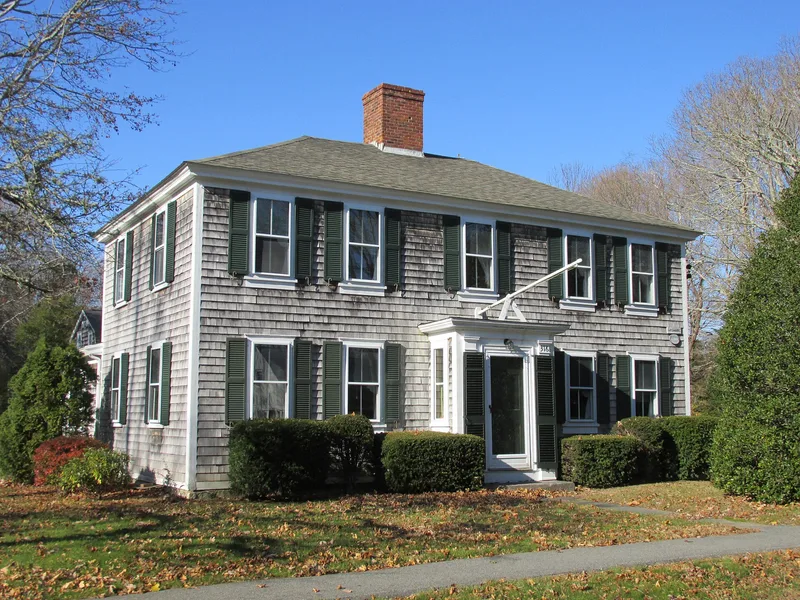
North Falmouth Village is a narrow, tree-lined settlement stretching roughly one and one-quarter mile along Old Main Road, a short distance inland from Buzzards Bay. Most of its buildings date from the early to mid-nineteenth century, though the oldest houses, such as the Shubal Nye House, predate about 1762. One- and two-and-a-half-story wood-frame houses, many of them Capes in Federal and Greek Revival styles, line the road behind picket fences and granite posts. Other landmarks include the Congregational Church, the cemetery with over 1,000 headstones, the Megansett Grange, a former tavern and an 1891 railroad bridge. The village grew through farming, coastal trade and whaling, with ship captains from the Nye family living here, and later became a summer colony. Because little has changed since the early twentieth century, and because a local historic district has protected it since 1975, the village keeps the look of a quiet New England community.
Significance in brief: The district preserves a largely intact village of Capes and 2½-story wood-frame houses, a church, a cemetery and a grange hall that document settlement from the late eighteenth century through its growth as a summer colony. Its history is tied to farming, coastal shipping and whaling by founding families such as the Nyes and Hatches. The period of significance is given as ca. 1762-1948.
Machine-generated summary. This summary was generated by a language model from the official nomination document and has not been reviewed line by line by an editor. It may contain errors. Check the source document before relying on any detail. Source: nomination document (PDF) · National Archives catalog entry. NRHP reference 98000121, listed February 20, 1998. Summary generated October 2026 (model claude-sonnet-5-5, prompt v1.0-2026-10-29, confidence medium).
Key facts
| Address | 85-408 Old Main Rd., and 6 Wild Harbor Rd., Falmouth |
|---|---|
| County | Barnstable County |
| Listed | February 20, 1998 |
| Reference number | 98000121 |
| Resource type | District |
| Period of significance | ca. 1762-1948 |
| Architectural style | Greek Revival, Victorian, Colonial Revival, Federal and Georgian, with Spanish Revival, Bungalow/Craftsman, Foursquare and other styles |
| Areas of significance | Social History, Entertainment/Recreation, Commerce, Exploration/Settlement, Architecture |
| Level of significance | Local |
| Status (as stated in the nomination) | The district retains its historic character, with 71 contributing and 51 non-contributing resources. The 1891 railroad bridge was rated in poor condition in 1992. |
| Acreage | 95.5 |
| Coordinates | 41.64722, -70.61755 (NPS GIS) |
What listing means for this property
This is a historic district. Buildings within its boundary are either contributing (they add to the district's significance) or non-contributing. Owners of contributing income-producing buildings can claim the 20% federal rehabilitation tax credit; homeowners should look at state credits. National Register districts impose no design review by themselves; a local historic district ordinance, if one exists, does (the difference explained).
General information, not legal or tax advice. Rules change; confirm with your State Historic Preservation Office or a qualified adviser.
Sources and further reading
- National Park Service, National Register of Historic Places database (snapshot May 2026), reference 98000121.
- Nomination form (PDF, National Archives) — catalog entry
- Wikipedia article (used for cross-checking only; text not reproduced here)
- Wikidata Q7055342
- This listing as JSON
Last updated October 2026. Found an error? See the editorial policy for how to report it.