Joliet East Side Historic District
Also known as: See Also:Jacob H. Henry House

Why it's listed
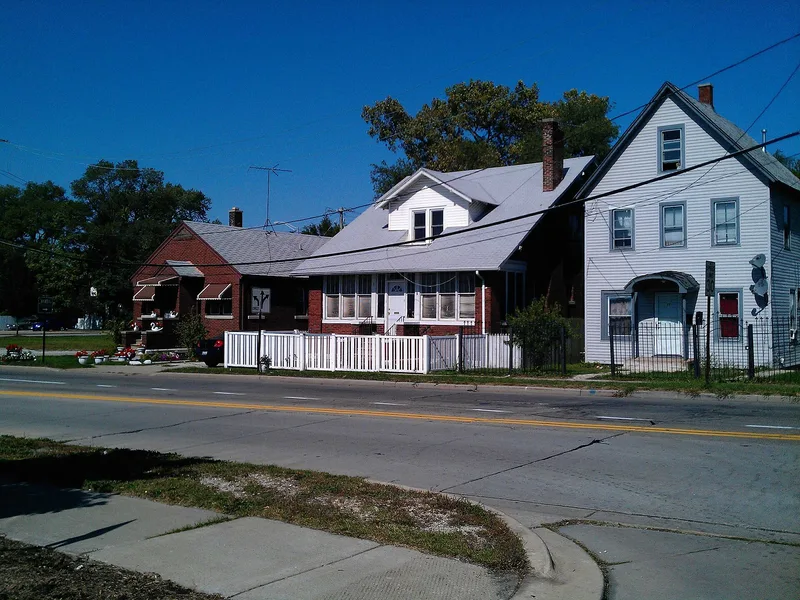
Southeast of Joliet's downtown, this roughly 100-acre neighborhood preserves a largely intact 19th-century residential setting. About 290 structures fill its grid of streets, most built between 1870 and 1900, with a few from the early 1850s. Queen Anne, Second Empire, Italianate and Georgian Revival houses stand alongside limestone churches, a school and an 1880s commercial row, the only completely intact block of its kind in the city. Original limestone curbs and decorative sidewalk tiles add to the character. The area grew after 1852 near the railroad depot and became the city's most prestigious address, especially after railroad magnate Jacob A. Henry built his large Second Empire mansion in 1873. Eastern Avenue became known as "Silk Stocking Row" for its politicians, industrialists, doctors and lawyers. Decline came with the Depression, when large houses were divided or became rooming houses, and later vinyl siding altered some buildings. Even so, the district remains a visible record of Joliet's growth.
Significance in brief: The district is one of Joliet's oldest neighborhoods and was once its most prominent, home to wealthy and influential citizens on what was called "Silk Stocking Row." It survives as a nearly intact 19th-century urban neighborhood with a varied mix of Victorian-era styles. It also holds the city's only completely intact block of 19th-century commercial row buildings.
Machine-generated summary. This summary was generated by a language model from the official nomination document and has not been reviewed line by line by an editor. It may contain errors. Check the source document before relying on any detail. Source: nomination document (PDF) · National Archives catalog entry. NRHP reference 80001418, listed August 15, 1980. Summary generated October 2026 (model claude-sonnet-5-5, prompt v1.0-2026-10-29, confidence medium).
Key facts
| Address | Roughly bounded by Washington and Union Sts., 4th and Eastern Aves., Joliet |
|---|---|
| County | Will County |
| Listed | August 15, 1980 |
| Reference number | 80001418 |
| Resource type | District |
| Period of significance | 1850-1920 |
| Architectural style | Victorian-era mix: Queen Anne, Second Empire, Italianate, Georgian Revival, Romanesque Revival, Gothic, Prairie School and Mission styles |
| Areas of significance | Architecture, Social History |
| Level of significance | Local |
| Status (as stated in the nomination) | Chiefly residential and largely intact, with about nine intrusions; some buildings have been altered by vinyl siding. The Jacob A. Henry Mansion was undergoing extensive restoration. |
| Acreage | 100 |
| Coordinates | 41.51897, -88.07263 (NPS GIS) |
What listing means for this property
This is a historic district. Buildings within its boundary are either contributing (they add to the district's significance) or non-contributing. Owners of contributing income-producing buildings can claim the 20% federal rehabilitation tax credit; homeowners should look at state credits. National Register districts impose no design review by themselves; a local historic district ordinance, if one exists, does (the difference explained).
General information, not legal or tax advice. Rules change; confirm with your State Historic Preservation Office or a qualified adviser.
Sources and further reading
- National Park Service, National Register of Historic Places database (snapshot May 2026), reference 80001418.
- Nomination form (PDF, National Archives) — catalog entry
- Wikipedia article (used for cross-checking only; text not reproduced here)
- Wikidata Q6269980
- This listing as JSON
Last updated October 2026. Found an error? See the editorial policy for how to report it.