Weyerhaeuser House
Also known as: House on the Hill

Why it's listed
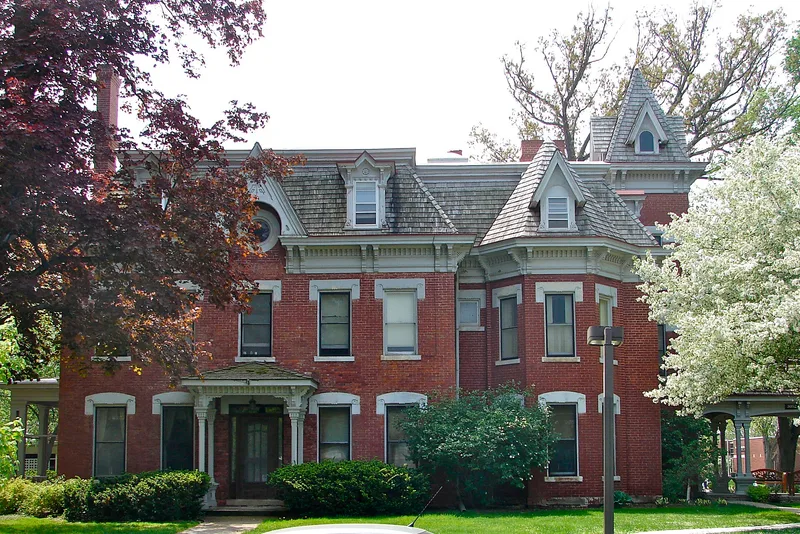
Known locally as the House on the Hill, this three-story painted brick mansion in Rock Island, Illinois, sits on a campus tract that was once a small farm. Frederick E. Weyerhaeuser, a German immigrant and lumber pioneer, bought the square two-story farmhouse in 1865. As his fortune grew, he had it rebuilt in stages, with major work in 1877, 1882-83 and 1888, and a complete renovation by his daughter and son-in-law in 1907. The result has a Mansard roof, a tower, a large oak-paneled entrance hall and a ballroom on the third floor. The dining room is the showpiece, with apple-blossom carvings, cherry panels, custom hardware and a stained glass window attributed to John La Farge. Much of that work was done by Old World craftsmen. The family gave the house and 26 acres to Augustana College in 1954, and it has been kept with its original furnishings.
Significance in brief: It was the long-time home of lumber magnate Frederick E. Weyerhaeuser, co-founder of the Weyerhaeuser and Denkmann Lumber Company, which grew into the Weyerhaeuser Company. The nomination presents it as a well-preserved 19th-century mansion of a leading American industrialist. Its elaborate dining room, built with Old World craftsmanship, is described as unique.
Machine-generated summary. This summary was generated by a language model from the official nomination document and has not been reviewed line by line by an editor. It may contain errors. Check the source document before relying on any detail. Source: nomination document (PDF) · National Archives catalog entry. NRHP reference 75000674, listed September 11, 1975. Summary generated October 2026 (model claude-sonnet-5-5, prompt v1.0-2026-10-29, confidence high).
Key facts
| Address | 3052 10th Ave., Rock Island |
|---|---|
| County | Rock Island County |
| Listed | September 11, 1975 |
| Reference number | 75000674 |
| Resource type | Building |
| Period of significance | c. 1865 and on (19th Century) |
| Architectural style | Second Empire |
| Areas of significance | Industry, Art, Architecture, Social History |
| Level of significance | State |
| Status (as stated in the nomination) | Listed in excellent condition and altered. Owned by a college, which maintains it with original furnishings and uses the first floor for receptions, dinners, conferences and other events. It is described as a house museum. |
| Acreage | 6 |
| Coordinates | 41.50132, -90.55532 (NPS GIS) |
What listing means for this property
National Register listing is honorary for a privately owned home: it does not by itself restrict what an owner may do with their own money, and it does not require public access. Restrictions come from local landmark or historic-district ordinances, which are separate (how they differ).
Owner-occupied houses are not eligible for the 20% federal rehabilitation tax credit, which applies to income-producing buildings, but many states offer credits for homeowners. Listing also opens the door to preservation easements and to buying a plaque. Start with what listing means for homeowners, renovating a listed house and selling one.
General information, not legal or tax advice. Rules change; confirm with your State Historic Preservation Office or a qualified adviser.
Sources and further reading
- National Park Service, National Register of Historic Places database (snapshot May 2026), reference 75000674.
- Nomination form (PDF, National Archives) — catalog entry
- Wikipedia article (used for cross-checking only; text not reproduced here)
- Wikidata Q7990316
- This listing as JSON
Last updated October 2026. Found an error? See the editorial policy for how to report it.