Benjamin, Ruben M., House

Why it's listed
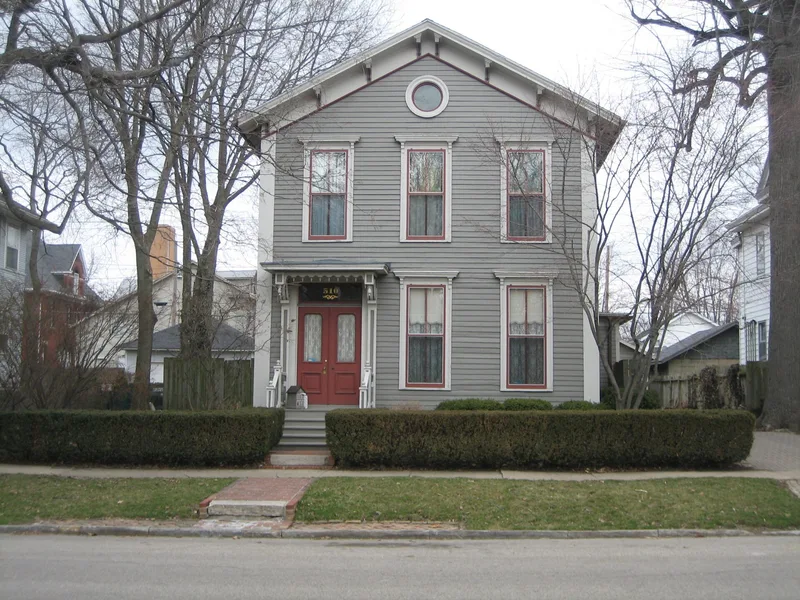
Built in 1856, this white-painted wood house at 510 E. Grove Street in Bloomington is a two-story, gable-fronted residence with shallow brackets supporting the roof, a bay window on the west side and a small circular window high on the street facade. Its builder was John L. Routt, then a local carpenter, who later served as Sheriff of McLean County, U.S. Marshal and the first elected governor of Colorado. The house is best known as the home of lawyer Ruben M. Benjamin, who moved in during 1856 and lived there for the rest of his life. A leader at the 1869 Illinois constitutional convention, he argued for legislative power to regulate railroad and warehouse rates. He then helped prosecute the Chicago and Alton Railroad case and Munn vs. Illinois. He later served as county judge and as first dean of the Illinois Wesleyan law school.
Significance in brief: It was the home of Ruben M. Benjamin, the lawyer largely responsible for developing the Granger Cases in Illinois, including Chicago and Alton Railroad vs. the People and Munn vs. Illinois. His arguments for state regulation of railroad and warehouse rates were later accepted by the U.S. Supreme Court. The house is also the only Bloomington home known for certain to have been built by Routt, later the first governor of the state of Colorado.
Machine-generated summary. This summary was generated by a language model from the official nomination document and has not been reviewed line by line by an editor. It may contain errors. Check the source document before relying on any detail. Source: nomination document (PDF) · National Archives catalog entry. NRHP reference 78003109, listed August 30, 1978. Summary generated October 2026 (model claude-sonnet-5-5, prompt v1.0-2026-10-29, confidence high).
Key facts
| Address | 510 E. Grove St., Bloomington |
|---|---|
| County | McLean County |
| Listed | August 30, 1978 |
| Reference number | 78003109 |
| Resource type | Building |
| Period of significance | 1800-1899 |
| Architect / builder | John L. Routt (carpenter/builder) |
| Architectural style | Simple classic revival house |
| Areas of significance | Law |
| Level of significance | National |
| Status (as stated in the nomination) | Listed in excellent condition and in use as a private residence; interior room arrangements somewhat altered since the nineteenth century. |
| Acreage | 0.9 |
| Within district | East Grove Street District-Bloomington |
| Coordinates | 40.47804, -88.98789 (NPS GIS) |
What listing means for this property
National Register listing is honorary for a privately owned home: it does not by itself restrict what an owner may do with their own money, and it does not require public access. Restrictions come from local landmark or historic-district ordinances, which are separate (how they differ).
Owner-occupied houses are not eligible for the 20% federal rehabilitation tax credit, which applies to income-producing buildings, but many states offer credits for homeowners. Listing also opens the door to preservation easements and to buying a plaque. Start with what listing means for homeowners, renovating a listed house and selling one.
General information, not legal or tax advice. Rules change; confirm with your State Historic Preservation Office or a qualified adviser.
Sources and further reading
- National Park Service, National Register of Historic Places database (snapshot May 2026), reference 78003109.
- Nomination form (PDF, National Archives) — catalog entry
- Wikipedia article (used for cross-checking only; text not reproduced here)
- Wikidata Q7375982
- This listing as JSON
Last updated October 2026. Found an error? See the editorial policy for how to report it.