Trumbull, Lyman, House

Why it's listed
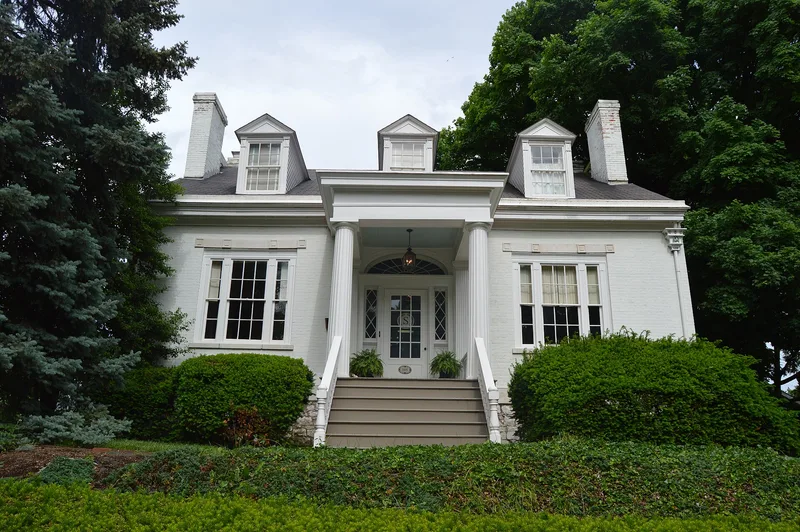
This 1 1/2-story red brick house at 1105 Henry Street in Alton, Illinois, is linked to Lyman Trumbull, who lived there from 1849 until about 1863. The date of construction is unknown but is believed to fall between 1820 and 1837. The gable-roofed building has a limestone foundation, six-over-six windows with green louvered shutters, a central entrance with sidelights and a semi-elliptical fanlight, and a single-story L-shaped rear addition. Inside, a central hall divides the original block, and the basement holds the original kitchen and dining room. Trumbull served in the U.S. Senate from 1855 to 1873 and chaired the Judiciary Committee from 1861 to 1871. He wrote the Confiscation Acts, introduced the Freedmen's Bureau bill and the Civil Rights Act of 1866, and led the fight for the 13th amendment. He also backed the first civil service reform law and sought the Liberal Republican presidential nomination in 1872. The house remains a private residence undergoing restoration.
Significance in brief: It was the Alton home of Lyman Trumbull from 1849 to about 1863. Trumbull was a U.S. Senator from Illinois (1855-1873) and chaired the Senate Judiciary Committee, where he wrote and guided major Civil War and Reconstruction legislation, including the Confiscation Acts, the Freedmen's Bureau bill, the Civil Rights Act of 1866 and the 13th amendment. The form cites political significance.
Machine-generated summary. This summary was generated by a language model from the official nomination document and has not been reviewed line by line by an editor. It may contain errors. Check the source document before relying on any detail. Source: nomination document (PDF) · National Archives catalog entry. NRHP reference 75000667, listed May 15, 1975. Summary generated October 2026 (model claude-sonnet-5-5, prompt v1.0-2026-10-29, confidence medium).
Key facts
| Address | 1105 Henry St., Alton |
|---|---|
| County | Madison County |
| Listed | May 15, 1975 |
| Reference number | 75000667 |
| Resource type | Building |
| Period of significance | 1849-1880 |
| Areas of significance | Politics/Government |
| Level of significance | National |
| National Historic Landmark | Yes, designated May 15, 1975 |
| Status (as stated in the nomination) | Described as in good condition and only slightly altered, in use as a private residence, with restoration by the present owners nearly complete. |
| Acreage | 0.9 |
| Within district | Middletown Historic District |
| Coordinates | 38.89717, -90.17595 (NPS GIS) |
What listing means for this property
National Register listing is honorary for a privately owned home: it does not by itself restrict what an owner may do with their own money, and it does not require public access. Restrictions come from local landmark or historic-district ordinances, which are separate (how they differ).
Owner-occupied houses are not eligible for the 20% federal rehabilitation tax credit, which applies to income-producing buildings, but many states offer credits for homeowners. Listing also opens the door to preservation easements and to buying a plaque. Start with what listing means for homeowners, renovating a listed house and selling one.
General information, not legal or tax advice. Rules change; confirm with your State Historic Preservation Office or a qualified adviser.
Sources and further reading
- National Park Service, National Register of Historic Places database (snapshot May 2026), reference 75000667.
- Nomination form (PDF, National Archives) — catalog entry
- Wikipedia article (used for cross-checking only; text not reproduced here)
- Wikidata Q6708095
- This listing as JSON
Last updated October 2026. Found an error? See the editorial policy for how to report it.