Christian Hill Historic District
Also known as: See Also:Alton Military Prison Site
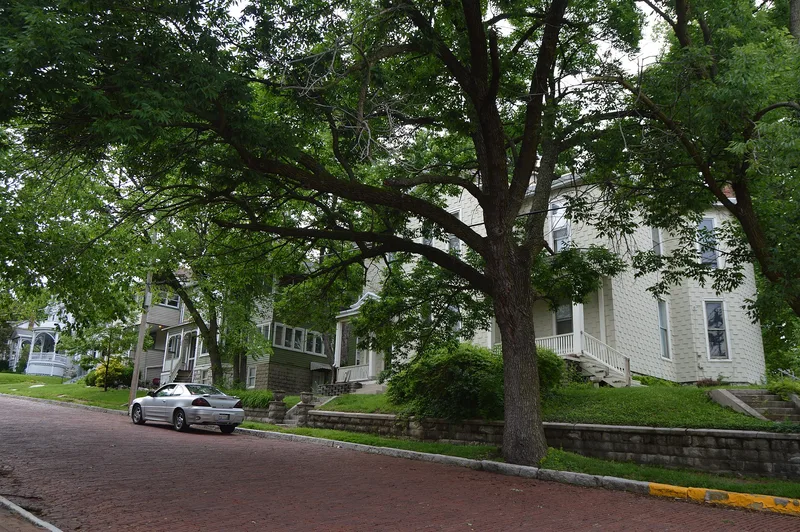

Why it's listed
Christian Hill is a residential neighborhood on the Mississippi River bluffs just west of downtown Alton, Illinois. Its boundaries follow the hill itself, and its streets bend to the topography, with brick paving, limestone retaining walls and steep grades. Of 274 structures, 72 were judged especially significant, and most of the rest predate World War I. The district was listed for its concentration of pre-Civil War buildings, many in the Federal style dating from the 1830s, alongside Italianate, Second Empire and Queen Anne houses built up to about 1910. Development began in the early 1830s, when the state penitentiary opened nearby. The neighborhood took its name after the Catholic church moved up the hill in the 1850s and became the cathedral. The site of Elijah Lovejoy's 1837 murder lies at its edge. Few changes have occurred over the last half century, and restoration work has been extensive.
Significance in brief: The district holds one of the finest and densest concentrations of pre-Civil War architecture in Illinois, including notable Federal-style commercial and residential buildings. Its steep topography and later 19th-century development create a varied but cohesive urban landscape. Individual sites tie to events such as the 1837 murder of abolitionist editor Elijah Lovejoy and the Alton State Penitentiary.
Machine-generated summary. This summary was generated by a language model from the official nomination document and has not been reviewed line by line by an editor. It may contain errors. Check the source document before relying on any detail. Source: nomination document (PDF) · National Archives catalog entry. NRHP reference 78001165, listed May 22, 1978. Summary generated October 2026 (model claude-sonnet-5-5, prompt v1.0-2026-10-29, confidence medium).
Key facts
| Address | Roughly bounded by Broadway, Belle, 7th, Cliff, Bluff, and State Sts., Alton |
|---|---|
| County | Madison County |
| Listed | May 22, 1978 |
| Reference number | 78001165 |
| Resource type | District |
| Architect / builder | Lucas Pfeiffenberger (architect, Pfeiffenberger House); Theodore Link (Hayner Library) |
| Architectural style | Federal, Greek Revival transition, Italianate, Second Empire, Queen Anne, Romanesque Revival |
| Areas of significance | Industry, Historic - Non-Aboriginal, Politics/Government, Architecture, Religion, Social History |
| Level of significance | State |
| Status (as stated in the nomination) | Condition marked good; mostly residential with some commercial, religious and educational uses. Restoration described as extensive in recent years, with only 8 intrusive or heavily altered buildings (2.9%). |
| Acreage | 106 |
| Coordinates | 38.89500, -90.19219 (NPS GIS) |
What listing means for this property
This is a historic district. Buildings within its boundary are either contributing (they add to the district's significance) or non-contributing. Owners of contributing income-producing buildings can claim the 20% federal rehabilitation tax credit; homeowners should look at state credits. National Register districts impose no design review by themselves; a local historic district ordinance, if one exists, does (the difference explained).
General information, not legal or tax advice. Rules change; confirm with your State Historic Preservation Office or a qualified adviser.
Sources and further reading
- National Park Service, National Register of Historic Places database (snapshot May 2026), reference 78001165.
- Nomination form (PDF, National Archives) — catalog entry
- Wikipedia article (used for cross-checking only; text not reproduced here)
- Wikidata Q16826724
- This listing as JSON
Last updated October 2026. Found an error? See the editorial policy for how to report it.