Dwight Chicago and Alton Railroad Depot
Also known as: Dwight Railroad Depot

Why it's listed
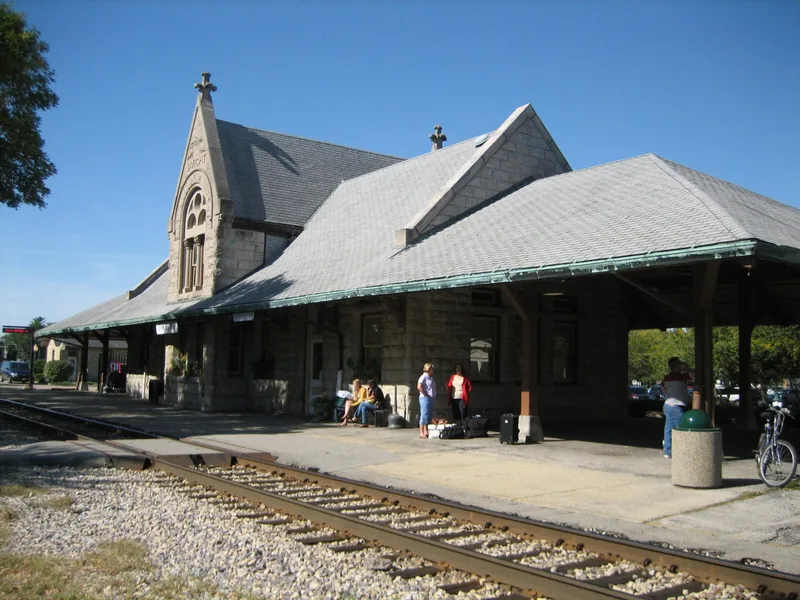
Dwight's railroad depot on East Street was built in 1891 to designs by Chicago architect Henry Ives Cobb, who also designed early University of Chicago buildings and the Newberry Library. The 75-by-25-foot station is Richardsonian Romanesque in style, with Bedford blue stone walls from Indiana, a Joliet stone foundation, twin gables carved with the town name, and quatrefoil ornaments. Inside, the original oak finish, two waiting rooms and fireplaces served travelers. A larger station was needed after the Keeley Gold Cure drew hundreds of patients to Dwight by train, replacing an 1854 frame depot. Visitors over the years included William Jennings Bryan and Theodore Roosevelt. The interior was remodeled in 1946 and the slate roof replaced. Passenger service ended in 1971, and the building became office and storage space for the railroad. It is valued as a fine example of 1890s station architecture and for its role in the local economy.
Significance in brief: The depot is a fine example of Richardsonian Romanesque design and the work of Chicago architect Henry Ives Cobb. It also played an important role in the local economy, as a larger station was needed for visitors arriving by train to the Keeley Gold Cure in Dwight. It is one of the few surviving 1890s railroad stations on the Chicago to St. Louis line.
Machine-generated summary. This summary was generated by a language model from the official nomination document and has not been reviewed line by line by an editor. It may contain errors. Check the source document before relying on any detail. Source: nomination document (PDF) · National Archives catalog entry. NRHP reference 82000398, listed December 27, 1982. Summary generated October 2026 (model claude-sonnet-5-5, prompt v1.0-2026-10-29, confidence high).
Key facts
| Address | East St., Dwight |
|---|---|
| County | Livingston County |
| Listed | December 27, 1982 |
| Reference number | 82000398 |
| Resource type | Building |
| Period of significance | 1800-1899 |
| Architect / builder | Henry Ives Cobb |
| Architectural style | Richardsonian Romanesque |
| Criteria |
|
| Areas of significance | Transportation, Architecture |
| Level of significance | State |
| Status (as stated in the nomination) | Last train stopped in May 1971; used as office and storage space by the railroad, in fair condition with neglected maintenance, broken windows and a need for a new roof. |
| Acreage | 0.9 |
| Coordinates | 41.08608, -88.42859 (NPS GIS) |
What listing means for this property
For an income-producing building, listing (individually or as a contributing building in a district) is the gateway to the 20% federal rehabilitation tax credit on qualified rehabilitation costs, often stackable with state credits. Work claiming the credit must follow the Secretary of the Interior's Standards and be approved in advance.
Listing does not restrict a private owner acting without federal money or permits; where federal funding or licensing is involved, Section 106 review applies.
General information, not legal or tax advice. Rules change; confirm with your State Historic Preservation Office or a qualified adviser.
Sources and further reading
- National Park Service, National Register of Historic Places database (snapshot May 2026), reference 82000398.
- Nomination form (PDF, National Archives) — catalog entry
- Wikipedia article (used for cross-checking only; text not reproduced here)
- Wikidata Q5318100
- This listing as JSON
Last updated October 2026. Found an error? See the editorial policy for how to report it.