Chicago, Burlington, and Quincy Railroad Depot
Also known as: Batavia Depot Museum

Why it's listed
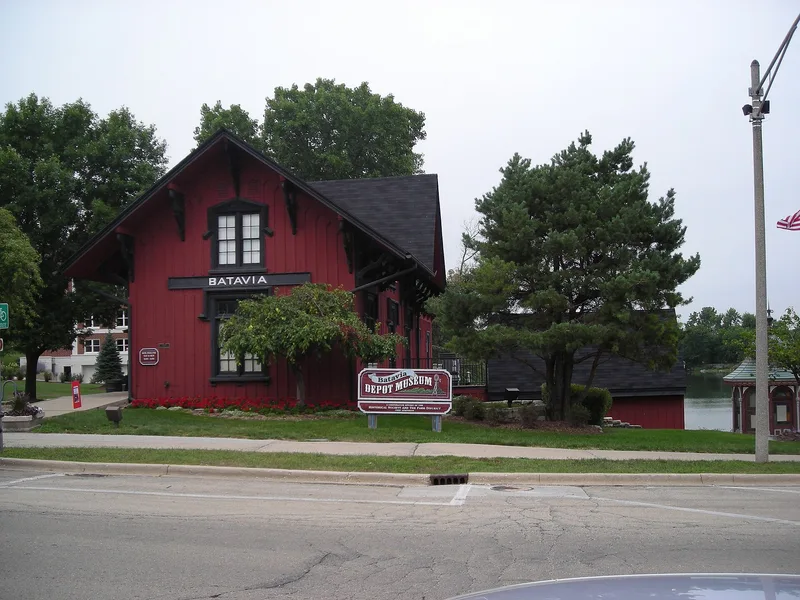
Built in 1854, this two-story wooden depot in Batavia, Illinois, was the first station constructed by the Aurora Branch Railroad, predecessor of the Chicago, Burlington and Quincy. It is finished in board and batten siding and has a steeply pitched gable roof, deep overhanging eaves, hood moldings, and wooden brackets with a trefoil outline, all hallmarks of Gothic Revival design. A flat-roofed addition from 1868 remains at the north end. After years of abandonment, the building was moved in 1973 to protect it from vandals and growing rail traffic, then restored as a museum with few exterior changes. The nomination links the depot to the railroad that fueled Batavia's windmill factories, which relied on rail shipping, and values it as one of roughly eight significant Gothic Revival depots in Illinois, only two of them in the northern half of the state.
Significance in brief: The depot is tied to the Aurora Branch Railroad, which the nomination credits with driving Batavia's prosperous windmill industry, and it was the first depot built by that company. It is also presented as a significant example of Gothic Revival design applied to small railroad depots in Illinois. The form cites a state survey listing about eight such depots in Illinois, only two of them in the northern half of the state.
Machine-generated summary. This summary was generated by a language model from the official nomination document and has not been reviewed line by line by an editor. It may contain errors. Check the source document before relying on any detail. Source: nomination document (PDF) · National Archives catalog entry. NRHP reference 79000842, listed June 6, 1979. Summary generated October 2026 (model claude-sonnet-5-5, prompt v1.0-2026-10-29, confidence medium).
Key facts
| Address | 155 Houston St., Batavia |
|---|---|
| County | Kane County |
| Listed | June 6, 1979 |
| Reference number | 79000842 |
| Resource type | Building |
| Period of significance | 1800-1899 |
| Architectural style | Gothic Revival |
| Areas of significance | Industry, Transportation, Architecture |
| Level of significance | Local |
| Status (as stated in the nomination) | Restored and in use as a museum owned by the Batavia Park District; moved in 1973 from its original location less than a mile away. |
| Acreage | 1.3 |
| Coordinates | 41.85148, -88.31047 (NPS GIS) |
What listing means for this property
For an income-producing building, listing (individually or as a contributing building in a district) is the gateway to the 20% federal rehabilitation tax credit on qualified rehabilitation costs, often stackable with state credits. Work claiming the credit must follow the Secretary of the Interior's Standards and be approved in advance.
Listing does not restrict a private owner acting without federal money or permits; where federal funding or licensing is involved, Section 106 review applies.
General information, not legal or tax advice. Rules change; confirm with your State Historic Preservation Office or a qualified adviser.
Sources and further reading
- National Park Service, National Register of Historic Places database (snapshot May 2026), reference 79000842.
- Nomination form (PDF, National Archives) — catalog entry
- Wikipedia article (used for cross-checking only; text not reproduced here)
- Wikidata Q4868668
- This listing as JSON
Last updated October 2026. Found an error? See the editorial policy for how to report it.