Unity Hall

Why it's listed
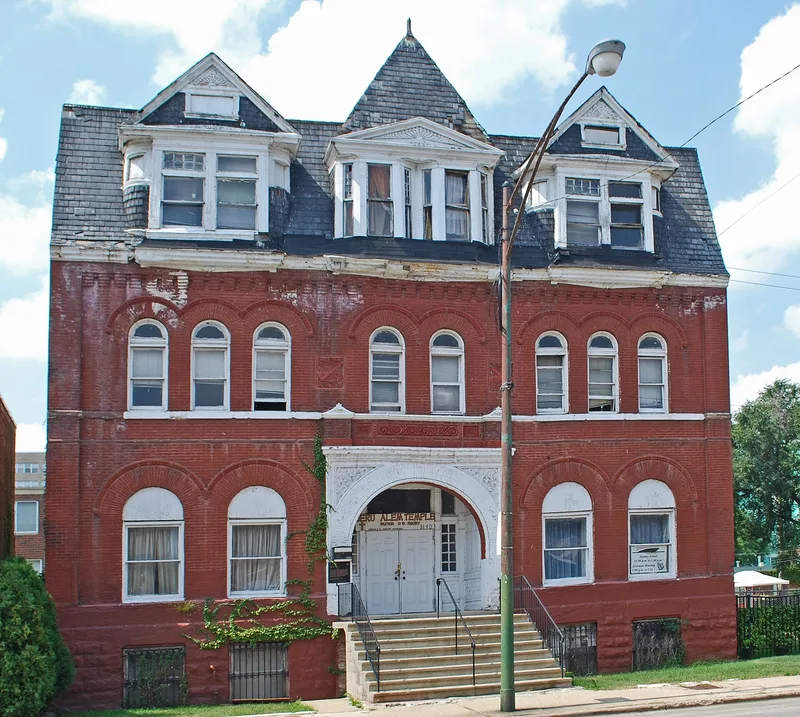
Unity Hall, at 3140 South Indiana Avenue in Chicago, is a three-story masonry building faced in red pressed brick with terra-cotta trim and a mansarded top story with ornamental shingles. Architect L.B. Dixon, who lived nearby and designed many residences in the Douglas community, completed it in the 1880s as the Lakeside Club, a Jewish social organization. The interior held small clubrooms at the front and a large assembly hall at the rear. From 1917 it served as headquarters of the Peoples Movement Club, led by Oscar Stanton De Priest. De Priest became the first black member of Chicago's City Council in 1915 and, in 1928, the first black person from the North elected to the U.S. House of Representatives. The club was among the best organized political groups in Black Metropolis. Later the building housed William Dawson, a long-standing Democratic leader. Now a church, it keeps most of its original design, apart from painted masonry and changes to the doorway and porch.
Significance in brief: The building is significant as the headquarters, from 1917, of the Peoples Movement Club, the political organization led by Oscar Stanton De Priest, Chicago's first black alderman and later the first black person from the North elected to the U.S. House of Representatives. It later served as headquarters for Democratic political leader William Dawson. It is also described as an excellent example of 1880s buildings in the Douglas community.
Machine-generated summary. This summary was generated by a language model from the official nomination document and has not been reviewed line by line by an editor. It may contain errors. Check the source document before relying on any detail. Source: nomination document (PDF) · National Archives catalog entry. NRHP reference 86001092, listed April 30, 1986. Summary generated October 2026 (model claude-sonnet-5-5, prompt v1.0-2026-10-29, confidence medium).
Key facts
| Address | 3140 S. Indiana Ave., Chicago |
|---|---|
| County | Cook County |
| Listed | April 30, 1986 |
| Reference number | 86001092 |
| Resource type | Building |
| Architect / builder | L.B. Dixon |
| Areas of significance | Black, Politics/Government, Social History |
| Level of significance | Local |
| Status (as stated in the nomination) | Now occupied as a church; it remains largely as originally designed except for painted exterior masonry and altered doorway, porch and first-floor windows (ca. 1950). |
| Acreage | 0.9 |
| Coordinates | 41.83773, -87.62248 (NPS GIS) |
What listing means for this property
National Register listing is honorary for a privately owned home: it does not by itself restrict what an owner may do with their own money, and it does not require public access. Restrictions come from local landmark or historic-district ordinances, which are separate (how they differ).
Owner-occupied houses are not eligible for the 20% federal rehabilitation tax credit, which applies to income-producing buildings, but many states offer credits for homeowners. Listing also opens the door to preservation easements and to buying a plaque. Start with what listing means for homeowners, renovating a listed house and selling one.
General information, not legal or tax advice. Rules change; confirm with your State Historic Preservation Office or a qualified adviser.
Sources and further reading
- National Park Service, National Register of Historic Places database (snapshot May 2026), reference 86001092.
- Nomination form (PDF, National Archives) — catalog entry
- Wikipedia article (used for cross-checking only; text not reproduced here)
- Wikidata Q16902342
- This listing as JSON
Last updated October 2026. Found an error? See the editorial policy for how to report it.