Unity Church

Why it's listed
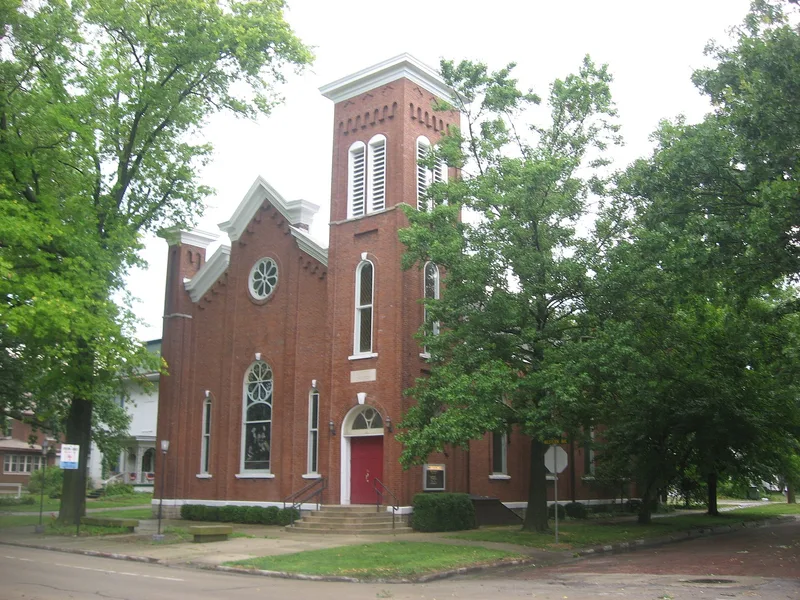
Built in 1872-1873 on Western Avenue in Mattoon, this red brick church was constructed by the town's Unitarian congregation for between $7,500 and $10,000, a large sum for the period. It has a gabled nave flanked by two flat-roofed towers, one holding the bell and the main entrance, along with a wheel window, round-arched openings with keystones, and an arcaded corbel table under the eaves. Later work includes stained glass added in 1907, a basement built in the 1930s, and an interior restoration finished in 1976, though the exterior has changed little since 1872. The architect is unknown because church records were lost when the Unitarian congregation dissolved. Lawyer Thomas Parkman Cushing Lane was a leading backer, and similar churches in Shelbyville suggest a plan drawn from published designs. It is the oldest standing religious building in Mattoon and a rare local example of architectural integrity, which is why it was listed as a local landmark.
Significance in brief: The nomination argues the church is significant mainly for its architecture and as the oldest standing religious structure in Mattoon. It is one of very few Mattoon buildings with architectural value and integrity, and the only religious building among six local structures named in a pre-World War II architecture survey. It also reflects the city's growth in the 1870s and East Coast influence on the West.
Machine-generated summary. This summary was generated by a language model from the official nomination document and has not been reviewed line by line by an editor. It may contain errors. Check the source document before relying on any detail. Source: nomination document (PDF) · National Archives catalog entry. NRHP reference 82002522, listed March 19, 1982. Summary generated October 2026 (model claude-sonnet-5-5, prompt v1.0-2026-10-29, confidence high).
Key facts
| Address | 220 Western Ave., Mattoon |
|---|---|
| County | Coles County |
| Listed | March 19, 1982 |
| Reference number | 82002522 |
| Resource type | Building |
| Period of significance | 1800-1899 |
| Architect / builder | Unknown |
| Architectural style | Early Romanesque (described in a supporting letter); the form does not give a formal style classification |
| Areas of significance | Architecture, Religion |
| Level of significance | Local |
| Status (as stated in the nomination) | Occupied and in religious use as Trinity Episcopal Church; condition listed as excellent, with the interior restored in 1976. |
| Acreage | 0.2 |
| Coordinates | 39.48337, -88.38339 (NPS GIS) |
What listing means for this property
Religious properties are listed for their architectural or historical significance, not their religious use. Listing is honorary and does not restrict the congregation's use of the building. The federal rehabilitation credit is generally unavailable unless part of the building is income-producing; some state programmes and preservation grants do cover religious buildings. Federal funding or permits trigger Section 106 review.
General information, not legal or tax advice. Rules change; confirm with your State Historic Preservation Office or a qualified adviser.
Sources and further reading
- National Park Service, National Register of Historic Places database (snapshot May 2026), reference 82002522.
- Nomination form (PDF, National Archives) — catalog entry
- Wikipedia article (used for cross-checking only; text not reproduced here)
- Wikidata Q16902351
- This listing as JSON
Last updated October 2026. Found an error? See the editorial policy for how to report it.