Washington-Wilkes Historical Museum
Also known as: Barnett-Slaton House

Why it's listed
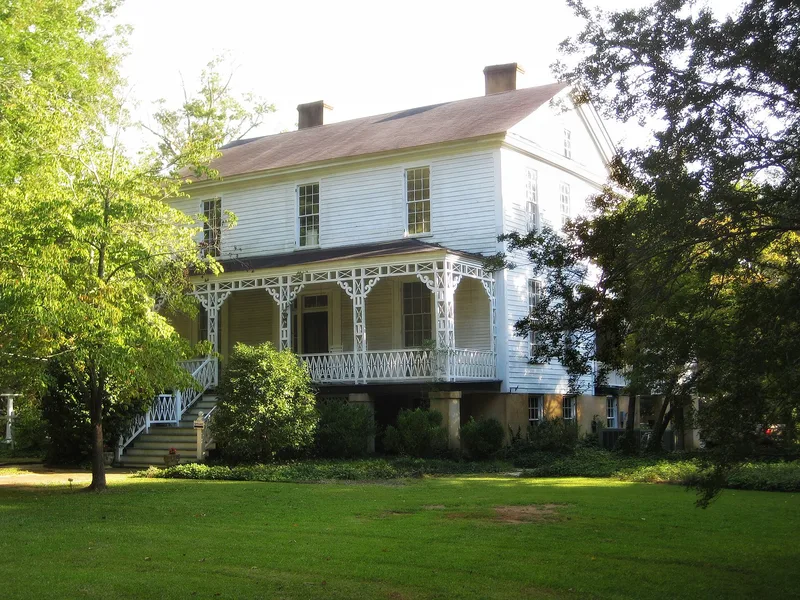
This white frame house at 308 East Robert Toombs Avenue in Washington, Georgia, now serves as a museum of antebellum life. Its oldest portion was built around 1835 or 1836 by Albert Gallatin Semmes. Samuel Barnett, Georgia's first Railroad Commissioner, bought the property in 1857 and greatly enlarged it with front rooms, hallways and the present staircase. The Barnett family kept it until 1913, and the Slaton family lived there until 1955. The city then acquired it and deeded it to the state. Architect Thomas G. Little directed restoration in 1958 and 1962, including the Downingesque trellis-work verandas. The house has 18 rooms, a restored kitchen on the ground floor, furnished parlors and a dining room on the main floor, and a Civil War relic collection upstairs. Its significance rests on both its museum role and its architecture. It grew by accretion into an unpretentious mansion, reflecting local building traditions rather than the grand columned image of plantation houses.
Significance in brief: It is a house museum representing life in antebellum Georgia, with furnished rooms, restored grounds and a notable Civil War relic collection. Architecturally, it grew by accretion from a modest early house into a mansion, showing local craft traditions and details from the Federal to the Downingesque styles.
Machine-generated summary. This summary was generated by a language model from the official nomination document and has not been reviewed line by line by an editor. It may contain errors. Check the source document before relying on any detail. Source: nomination document (PDF) · National Archives catalog entry. NRHP reference 70000227, listed May 13, 1970. Summary generated October 2026 (model claude-sonnet-5-5, prompt v1.0-2026-10-29, confidence high).
Key facts
| Address | 308 E. Robert Toombs Ave., Washington |
|---|---|
| County | Wilkes County |
| Listed | May 13, 1970 |
| Reference number | 70000227 |
| Resource type | Building |
| Period of significance | 19th and 20th centuries; specific dates c. 1835; c. 1857; restoration 1958, 1962 |
| Architect / builder | Albert Gallatin Semmes (earliest section); Samuel Barnett (1857 enlargement); Thomas G. Little, historical architect (restoration) |
| Architectural style | Federal to Downingesque details on a simple four-square form of two weatherboarded, shuttered cubes |
| Areas of significance | Landscape Architecture, Architecture, Social History |
| Level of significance | National |
| Status (as stated in the nomination) | Condition listed as excellent; used as a museum operated by the Georgia Historical Commission; restored in 1958 and 1962, with a later parapet restoration planned. |
| Acreage | 0.9 |
| Within district | Washington Historic District |
| Coordinates | 33.73540, -82.73403 (NPS GIS) |
What listing means for this property
National Register listing is honorary: it recognises significance and does not restrict what a private owner may do without federal money or permits. It unlocks the 20% federal rehabilitation tax credit for income-producing buildings, state credits in many states, and Section 106 review when federal agencies are involved. See what listing means in practice.
General information, not legal or tax advice. Rules change; confirm with your State Historic Preservation Office or a qualified adviser.
Sources and further reading
- National Park Service, National Register of Historic Places database (snapshot May 2026), reference 70000227.
- Nomination form (PDF, National Archives) — catalog entry
- Wikipedia article (used for cross-checking only; text not reproduced here)
- Wikidata Q17033772
- This listing as JSON
Last updated October 2026. Found an error? See the editorial policy for how to report it.