Holly Court
Also known as: Ficklen-Lyndon-Johnson House

Why it's listed
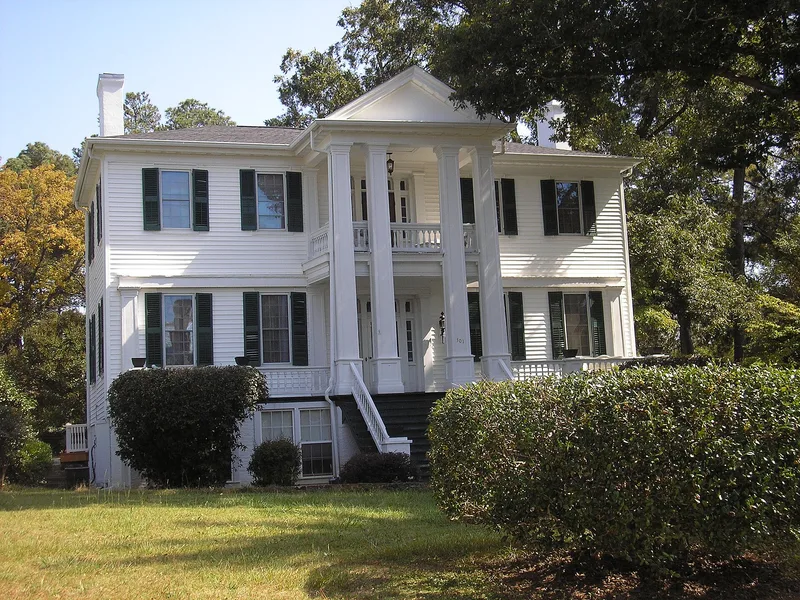
Holly Court is a two-story, white clapboard townhouse at 301 South Alexander Street in Washington, Georgia. It was made by joining two plain Federal period houses from the early 1830s. Around 1840 Dr. Fielding Ficklen, a planter, had his plantation house moved to the site by ox-cart and connected to the existing house by a wide cross hall. A tall pedimented portico with paired Tuscan columns was added to the front. The house shows the common local practice of combining and remodeling buildings to make a town residence for a planter with land elsewhere in the county. Its lot was once owned by Billy Hoxey, a free man of color and house carpenter. In 1864 Mrs. Jefferson Davis and her children took refuge there. Later owners included Ficklen's son Burwell, whose household likely developed the gardens, and George E. Lyndon, a mayor of Washington. The house is also noted as part of the Water-Liberty Street District.
Significance in brief: It is presented as an innovative example of the common ante-bellum Washington practice of combining and remodeling houses into a planter's townhouse. It conveys the monumental Greek Revival impression Dr. Fielding Ficklen sought. It was also the site of historic events, including a stay by Mrs. Jefferson Davis and her children in 1864.
Machine-generated summary. This summary was generated by a language model from the official nomination document and has not been reviewed line by line by an editor. It may contain errors. Check the source document before relying on any detail. Source: nomination document (PDF) · National Archives catalog entry. NRHP reference 72000406, listed April 11, 1972. Summary generated October 2026 (model claude-sonnet-5-5, prompt v1.0-2026-10-29, confidence high).
Key facts
| Address | 301 S. Alexander St., Washington |
|---|---|
| County | Wilkes County |
| Listed | April 11, 1972 |
| Reference number | 72000406 |
| Resource type | Building |
| Period of significance | 19th Century (specific dates c. 1833, c. 1840) |
| Architectural style | Federal period houses combined into an early Greek Revival townhouse |
| Areas of significance | Architecture, Social History |
| Level of significance | National |
| Status (as stated in the nomination) | Listed in good condition, altered, on its original site, and used as a private residence. The form marks it both occupied and unoccupied. |
| Acreage | 1.1 |
| Within district | Washington Historic District |
| Coordinates | 33.73345, -82.73653 (NPS GIS) |
What listing means for this property
National Register listing is honorary: it recognises significance and does not restrict what a private owner may do without federal money or permits. It unlocks the 20% federal rehabilitation tax credit for income-producing buildings, state credits in many states, and Section 106 review when federal agencies are involved. See what listing means in practice.
General information, not legal or tax advice. Rules change; confirm with your State Historic Preservation Office or a qualified adviser.
Sources and further reading
- National Park Service, National Register of Historic Places database (snapshot May 2026), reference 72000406.
- Nomination form (PDF, National Archives) — catalog entry
- Wikipedia article (used for cross-checking only; text not reproduced here)
- Wikidata Q16920110
- This listing as JSON
Last updated October 2026. Found an error? See the editorial policy for how to report it.