Campbell-Jordan House
Also known as: Duncan G. Campbell House
Campbell-Jordan House is a building in Washington, Wilkes County, Georgia, listed on the National Register of Historic Places on July 14, 1971 (reference number 71000288). The National Park Service records its significance in Architecture and Social History at the national level.
Facts from the NPS National Register database (); nomination summary October 2026. Last updated . Sources for each fact.

Approximate location: the National Park Service places this pin arbitrarily within the property, not at a surveyed point (stated accuracy ±12 m).
Why it's listed
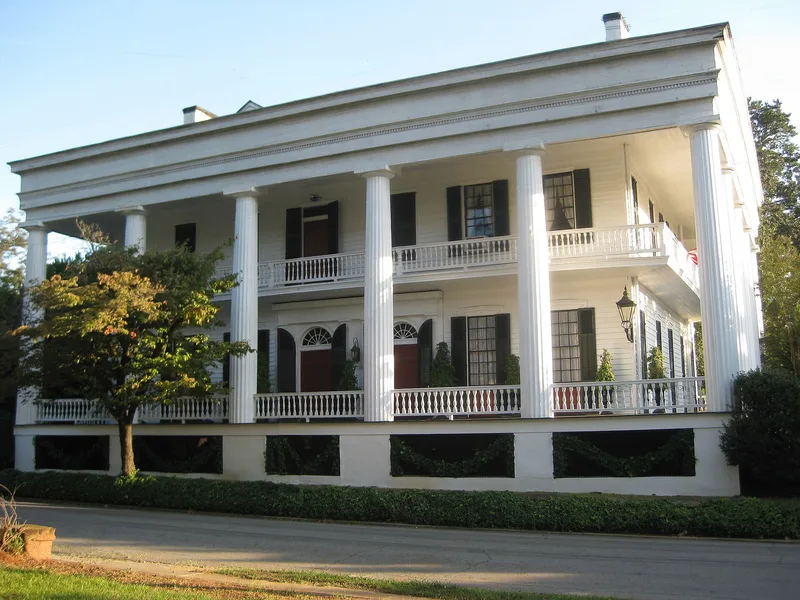
Two Federal period houses, built in the same style at different times, were joined into a single mansion at 208 Liberty Street in Washington, Georgia. The eastern section began around 1808 as a small two-story plantation plain house, and a matching western half followed, probably by 1813. Around 1841, during the ownership of merchant Aaron A. Cleveland, a Greek Doric peristyle colonnade and other Greek Revival details were added, creating a two-story porch with balconies on all four sides. Inside, the rooms remain Federal in style. The house sits directly beside the sidewalk, with open grounds to the south and west. Duncan G. Campbell lived on the lot, and his son John Archibald Campbell, later a U.S. Supreme Court Associate Justice, was born in the eastern section in 1811. Later owners included Andrew Green Semmes and Benjamin F. Jordan. Little has changed since before the Civil War, and the house is regarded as a landmark among the area's Greek Revival mansions.
Significance in brief: The nomination calls it the most monumental and complicated example of a typical Washington, Georgia pattern, in which older houses were remodeled into Greek Revival houses in the 1840s. Few alterations were made after the antebellum expansion, and its condition is excellent. Its growth from 1808 to 1841 is well documented, and it was the birthplace of Supreme Court Justice John Archibald Campbell.
Machine-generated summary. This summary was generated by a language model from the official nomination document and has not been reviewed line by line by an editor. It may contain errors. Check the source document before relying on any detail. Source: nomination document (PDF) · National Archives catalog entry. NRHP reference 71000288, listed July 14, 1971. Summary generated October 2026 (model claude-sonnet-5-5, prompt v1.0-2026-10-29, confidence high).
Key facts
| Official database NPS National Register database, ref. 71000288 , checked | |
|---|---|
| Address | 208 Liberty St., Washington |
| County | Wilkes County |
| Listed | July 14, 1971 |
| Reference number | 71000288 |
| Resource type | Building |
| Areas of significance | Architecture, Social History |
| Level of significance | National |
| National Historic Landmark | No |
| Acreage | 0.9 |
| Official document, machine-extracted Nomination form (National Archives) , checked | |
| Period of significance | 19th Century (specific dates c. 1808, c. 1813, 1841) |
| Architectural style | Greek Revival and Federal; described as a Classical Revival style townhouse |
| Status (as stated in the nomination) | Excellent condition, unaltered, on its original site; occupied as a private residence. |
| Official dataset NPS cultural-resource GIS (NRHP locations) | |
| Coordinates | 33.73373, -82.73737 |
| Computed Computed from NPS GIS district boundaries | |
| Within district | Washington Historic District |
What listing means for this property
National Register listing is honorary for a privately owned home: it does not by itself restrict what an owner may do with their own money, and it does not require public access. Restrictions come from local landmark or historic-district ordinances, which are separate (how they differ).
Owner-occupied houses are not eligible for the 20% federal rehabilitation tax credit, which applies to income-producing buildings, but many states offer credits for homeowners. Listing also opens the door to preservation easements and to buying a plaque. Start with what listing means for homeowners, renovating a listed house and selling one.
General information, not legal or tax advice. Rules change; confirm with your State Historic Preservation Office or a qualified adviser.
Questions about Campbell-Jordan House
When was Campbell-Jordan House added to the National Register of Historic Places?
Campbell-Jordan House was listed on July 14, 1971. Its National Register reference number is 71000288.
Is Campbell-Jordan House a National Historic Landmark?
No. The National Park Service database (snapshot of May 2026) lists Campbell-Jordan House on the National Register but does not record it as a National Historic Landmark.
Where is Campbell-Jordan House?
208 Liberty St., Washington, Wilkes County, Georgia; coordinates 33.73373, -82.73737.
Why is Campbell-Jordan House historically significant?
According to a machine-generated summary of its nomination form: The nomination calls it the most monumental and complicated example of a typical Washington, Georgia pattern, in which older houses were remodeled into Greek Revival houses in the 1840s. Few alterations were made after the antebellum expansion, and its condition is excellent. Its growth from 1808 to 1841 is well documented, and it was the birthplace of Supreme Court Justice John Archibald Campbell. Check the nomination document before relying on any detail.
Is Campbell-Jordan House in a historic district?
Yes. Its location falls within the Washington Historic District, itself listed on the National Register. (Computed from National Park Service boundary data; the district nomination's own list of contributing resources may differ.)
Where can I read the original nomination for Campbell-Jordan House?
The nomination form is a public record held by the National Archives: nomination document (PDF).
Sources and further reading
- National Park Service, National Register of Historic Places database (snapshot May 2026), reference 71000288.
- Nomination form (PDF, National Archives) — catalog entry
- Wikipedia article (used for cross-checking only; text not reproduced here)
- Wikidata Q16851214
- This listing as JSON
Last updated October 2026. Found an error? See the editorial policy for how to report it.