Wesleyan Methodist Campground and Tabernacle
Also known as: Holiness Campground

Why it's listed
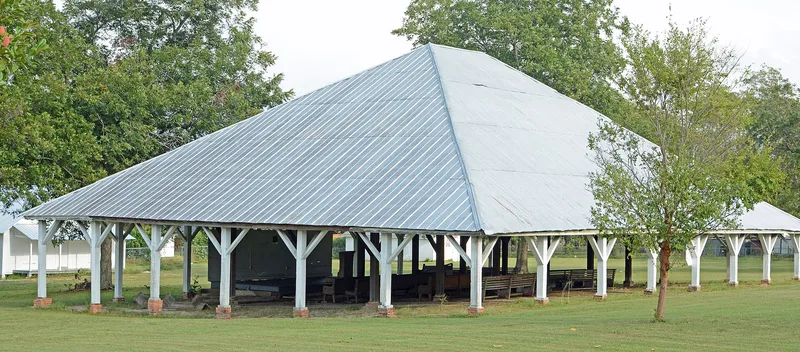
Wesleyan Methodist Campground and Tabernacle is a three-acre camp meeting site a few blocks from downtown Ashburn, Georgia. Its main feature is a pine post-and-beam tabernacle built in 1902 by R. V. Ayers and church members. The tabernacle has a large hipped metal roof, seats about 400 people, and is open on three sides, with only the wall behind the platform enclosed. Original movable pews remain. A frame kitchen and a sleeping room with eight small chambers, both from about 1914, complete the historic group; two buildings from about 1984 do not contribute. The campground is notable as an urban example in a state where such sites were usually rural, and as a surviving place of the Wesleyan Methodist faith, uncommon in Georgia. It hosted annual summer meetings for decades, drawing several hundred people. The City of Ashburn bought it in 1984 to prevent demolition, and it serves as a community meeting place.
Significance in brief: The nomination argues the tabernacle is a good, intact example of a camp meeting tabernacle, with post-and-beam construction, a large roof and an open-air meeting space. It is also an unusual urban campground in Georgia. It is significant in religion as a surviving site of the Wesleyan Methodist faith, which was rare in Georgia and is said to have six surviving campgrounds there.
Machine-generated summary. This summary was generated by a language model from the official nomination document and has not been reviewed line by line by an editor. It may contain errors. Check the source document before relying on any detail. Source: nomination document (PDF) · National Archives catalog entry. NRHP reference 98001485, listed December 12, 1998. Summary generated October 2026 (model claude-sonnet-5-5, prompt v1.0-2026-10-29, confidence high).
Key facts
| Address | 321 Gordon St., Ashburn |
|---|---|
| County | Turner County |
| Listed | December 12, 1998 |
| Reference number | 98001485 |
| Resource type | District |
| Period of significance | 1902-1948 |
| Architect / builder | R. V. Ayers (built the tabernacle in 1902 with several men of the church) |
| Architectural style | OTHER/tabernacle |
| Criteria |
|
| Areas of significance | Architecture, Religion |
| Level of significance | State |
| Status (as stated in the nomination) | Owned by the City of Ashburn since 1984 and used as a public meeting space; camp meetings were held as late as 1991, and the nomination says they are still held in August when possible. |
| Acreage | 3 |
| Coordinates | 31.70351, -83.64994 (NPS GIS) |
What listing means for this property
This is a historic district. Buildings within its boundary are either contributing (they add to the district's significance) or non-contributing. Owners of contributing income-producing buildings can claim the 20% federal rehabilitation tax credit; homeowners should look at state credits. National Register districts impose no design review by themselves; a local historic district ordinance, if one exists, does (the difference explained).
General information, not legal or tax advice. Rules change; confirm with your State Historic Preservation Office or a qualified adviser.
Sources and further reading
- National Park Service, National Register of Historic Places database (snapshot May 2026), reference 98001485.
- Nomination form (PDF, National Archives) — catalog entry
- Wikidata Q141812269
- This listing as JSON
Last updated October 2026. Found an error? See the editorial policy for how to report it.