Towns, George W. B., House
Also known as: Towns-Persons-Page House

Why it's listed
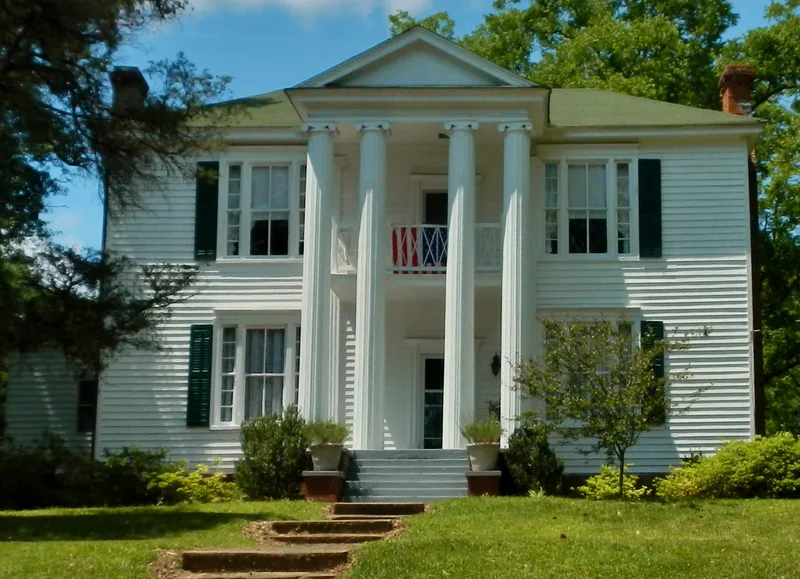
Begun in 1828, this two-story frame house in Talbotton, Georgia, began as a plain-style plantation dwelling built for George Washington Bonaparte Towns, an early settler and town commissioner. Towns became a successful lawyer, state legislator, congressman and, from 1847 to 1851, Governor of Georgia. A second two-story, three-bay house was later added behind the first, making an L-shaped plan, and a four-columned Ionic portico was added to the front, probably after 1838. Twentieth-century rooms and a hipped roof came later. Inside are a wainscotted parlor with a plaster ceiling medallion, late Federal mantels, a cross hall and a former ballroom. Behind the house stand the original brick kitchen and a seven-seat brick privy, of which a replica was built at Stone Mountain State Park. The Persons family owned the property from about 1852-54 until 1968. The house is valued as an example of vernacular architecture evolving with a family, and for its link to Towns.
Significance in brief: The nomination presents the house as an example of how Georgia vernacular architecture changed as a family's needs and tastes grew. It is also tied to Towns, an early Talbotton settler, lawyer, congressman and Governor of Georgia from 1847 to 1851. Reviewers saw it as a marginal house, but one with value as a development of styles and as a lawmaker's house.
Machine-generated summary. This summary was generated by a language model from the official nomination document and has not been reviewed line by line by an editor. It may contain errors. Check the source document before relying on any detail. Source: nomination document (PDF) · National Archives catalog entry. NRHP reference 73000644, listed May 7, 1973. Summary generated October 2026 (model claude-sonnet-5-5, prompt v1.0-2026-10-29, confidence medium).
Key facts
| Address | GA 208, Talbotton |
|---|---|
| County | Talbot County |
| Listed | May 7, 1973 |
| Reference number | 73000644 |
| Resource type | Building |
| Period of significance | 19th Century (specific date 1828) |
| Architectural style | Vernacular plantation plain style with a later Ionic portico and late Federal mantels |
| Areas of significance | Politics/Government, Architecture |
| Level of significance | State |
| Status (as stated in the nomination) | Listed as in good condition, altered, on its original site, and occupied as a private residence. |
| Acreage | 10 |
| Coordinates | 32.67883, -84.54575 (NPS GIS) |
What listing means for this property
National Register listing is honorary for a privately owned home: it does not by itself restrict what an owner may do with their own money, and it does not require public access. Restrictions come from local landmark or historic-district ordinances, which are separate (how they differ).
Owner-occupied houses are not eligible for the 20% federal rehabilitation tax credit, which applies to income-producing buildings, but many states offer credits for homeowners. Listing also opens the door to preservation easements and to buying a plaque. Start with what listing means for homeowners, renovating a listed house and selling one.
General information, not legal or tax advice. Rules change; confirm with your State Historic Preservation Office or a qualified adviser.
Sources and further reading
- National Park Service, National Register of Historic Places database (snapshot May 2026), reference 73000644.
- Nomination form (PDF, National Archives) — catalog entry
- Wikidata Q134457972
- This listing as JSON
Last updated October 2026. Found an error? See the editorial policy for how to report it.