Griffin Commercial Historic District

Why it's listed
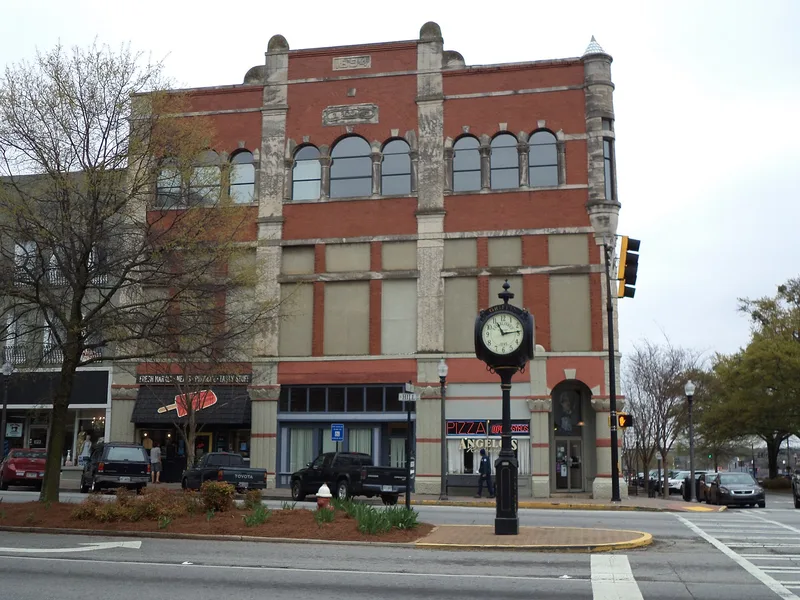
Griffin's historic downtown spreads across roughly eight blocks centered on Hill and Solomon Streets, in a grid first surveyed in 1840 to serve the railroad. Most buildings are attached, one- to four-story brick storefronts with corbeled or pressed-metal cornices, arched windows and cast-iron columns, reflecting Italianate, Neoclassical and Art Deco influences. Larger landmarks include the 1892 Opera House/Odd Fellows Hall, the Griffin Hotel, and the five-story Professional Building of 1929. Government buildings include a 1910 former post office and a Colonial Revival city hall and fire station. Three black churches from about 1900 and brick warehouses along the tracks complete the mix. Landscaped medians added in 1895 and hexagonal sidewalk pavers give the streets a distinctive look. The district was listed for its association with the founding and commercial growth of the city's business center and for its intact collection of buildings, with a period of significance from 1840 to 1938.
Significance in brief: The district is argued to be significant under Criteria A and C for its intact concentration of commercial, governmental, religious and industrial buildings. It also preserves the 1840 grid town plan tied to the railroad, 1890s landscaped street medians and hexagonal sidewalk pavers. It documents the commercial and transportation history of the city and county.
Machine-generated summary. This summary was generated by a language model from the official nomination document and has not been reviewed line by line by an editor. It may contain errors. Check the source document before relying on any detail. Source: nomination document (PDF) · National Archives catalog entry. NRHP reference 88002310, listed November 16, 1988. Summary generated October 2026 (model claude-sonnet-5-5, prompt v1.0-2026-10-29, confidence high).
Key facts
| Address | Roughly bounded by Central Alley, Sixth, Taylor and Eighth Sts., Griffin |
|---|---|
| County | Spalding County |
| Listed | November 16, 1988 |
| Reference number | 88002310 |
| Resource type | District |
| Period of significance | 1840-1938 |
| Architect / builder | Haralson Bleckley; US Treasury Department Supervising Architect |
| Architectural style | Italianate, Commercial Style, Classical Revival, Art Deco |
| Criteria |
|
| Areas of significance | Landscape Architecture, Commerce, Transportation, Exploration/Settlement, Architecture |
| Level of significance | Local |
| Status (as stated in the nomination) | Development has continued to the present; many storefronts have been modernized, though most upper facades retain original detail. The Griffin Hotel is no longer used as a hotel. |
| Acreage | 28 |
| Coordinates | 33.24922, -84.26396 (NPS GIS) |
What listing means for this property
This is a historic district. Buildings within its boundary are either contributing (they add to the district's significance) or non-contributing. Owners of contributing income-producing buildings can claim the 20% federal rehabilitation tax credit; homeowners should look at state credits. National Register districts impose no design review by themselves; a local historic district ordinance, if one exists, does (the difference explained).
General information, not legal or tax advice. Rules change; confirm with your State Historic Preservation Office or a qualified adviser.
Sources and further reading
- National Park Service, National Register of Historic Places database (snapshot May 2026), reference 88002310.
- Nomination form (PDF, National Archives) — catalog entry
- Wikipedia article (used for cross-checking only; text not reproduced here)
- Wikidata Q49496383
- This listing as JSON
Last updated October 2026. Found an error? See the editorial policy for how to report it.