Hawkinsville Commercial and Industrial Historic District

Why it's listed
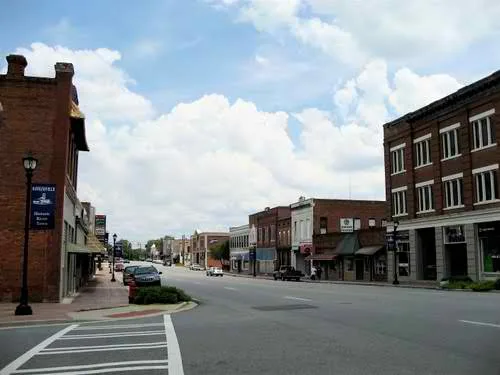
Hawkinsville's downtown and industrial belt sit on a bluff above the Ocmulgee River in central Georgia. The district pairs a two-block commercial core along Commerce Street with cotton, peanut and pecan processing buildings that curve around the north, south and east sides of the city. Downtown, one- and two-story brick storefronts display Italianate, Classical Revival, Romanesque Revival and Art Deco styling. Landmarks include the 1880 Dortch Building, the 1907 City Hall and Auditorium, the 1908 hotel building, the 1917 firehouse and the Pulaski County Courthouse. The industrial side includes gins, mills, warehouses, silos and elevators, mostly from the early 1900s through the 1950s. The district was recognized for its architecture and for what it shows about local commerce and industry. Rail connections arrived in 1868 and 1902, and cotton gave way to peanuts and pecans after the Depression. Its period of significance runs from about 1830 to 1954.
Significance in brief: The district is argued to be significant under Criteria A and C at the local level, in architecture, commerce, industry, community planning and development, and politics/government. It shows Hawkinsville's growth as a river, rail and cotton-trading center, and its later shift to peanut and pecan processing. It also contains a range of commercial and civic architecture from Italianate to International Style.
Machine-generated summary. This summary was generated by a language model from the official nomination document and has not been reviewed line by line by an editor. It may contain errors. Check the source document before relying on any detail. Source: nomination document (PDF) · National Archives catalog entry. NRHP reference 04001349, listed December 13, 2004. Summary generated October 2026 (model claude-sonnet-5-5, prompt v1.0-2026-10-29, confidence medium).
Key facts
| Address | Roughly bounded by Dooly, Broad, Houston, and 3rd Sts., Hawkinsville |
|---|---|
| County | Pulaski County |
| Listed | December 13, 2004 |
| Reference number | 04001349 |
| Resource type | District |
| Period of significance | c.1830-1954 |
| Architect / builder | A.V. Bryan & Co (Pulaski County Courthouse); E.A. Burch (Dortch Building); W. R. Gunn (City Hall/Auditorium); J. L. Huggins (contractor); J.C. Keel (Dortch Building builder); Louis A. Simon (Supervising Architect of the Treasury) |
| Architectural style | Late Victorian (Italianate, Romanesque), Classical Revival, Italian Renaissance, Colonial Revival, International Style, Art Deco, and brick, wood-frame and metal-frame warehouses |
| Criteria |
|
| Areas of significance | Architecture, Commerce, Industry, Community Planning and Development, Politics/Government |
| Level of significance | Local |
| Status (as stated in the nomination) | The district is mostly in active commercial, government and industrial use. The Union Passenger Station is used as offices and storage, and the rail depot function is listed as vacant or not in use. |
| Acreage | 60 |
| Coordinates | 32.28524, -83.46689 (NPS GIS) |
What listing means for this property
This is a historic district. Buildings within its boundary are either contributing (they add to the district's significance) or non-contributing. Owners of contributing income-producing buildings can claim the 20% federal rehabilitation tax credit; homeowners should look at state credits. National Register districts impose no design review by themselves; a local historic district ordinance, if one exists, does (the difference explained).
General information, not legal or tax advice. Rules change; confirm with your State Historic Preservation Office or a qualified adviser.
Sources and further reading
- National Park Service, National Register of Historic Places database (snapshot May 2026), reference 04001349.
- Nomination form (PDF, National Archives) — catalog entry
- Wikipedia article (used for cross-checking only; text not reproduced here)
- Wikidata Q29093519
- This listing as JSON
Last updated October 2026. Found an error? See the editorial policy for how to report it.