Everett Square Historic District
Also known as: See Also:Peach County Courthouse

Why it's listed
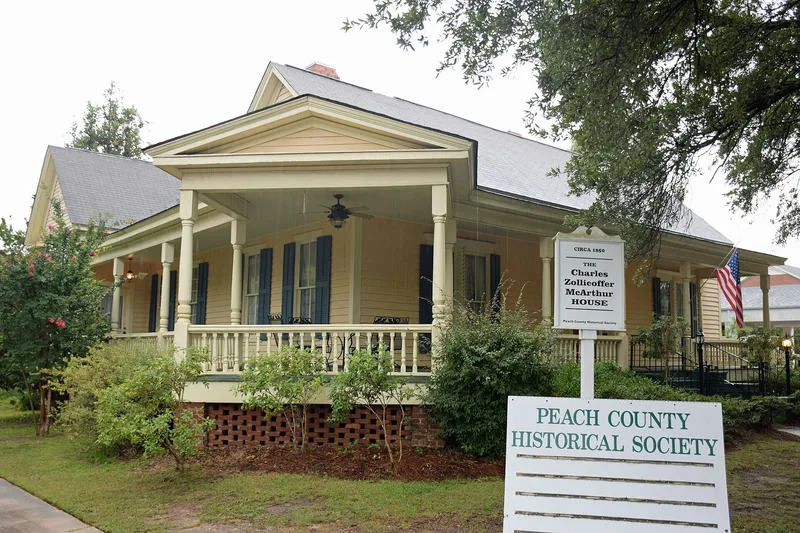
Everett Square Historic District covers roughly 160 acres west and northwest of downtown Fort Valley, Georgia. It grew from a parcel of land that founder James Everett gave to the city in 1836 for community use, when the town's grid plan was established. Homes developed between the square and the commercial center, and the neighborhood expanded after the railroad arrived in 1852, with its strongest growth between the 1870s and 1920s. The district contains houses from the 1850s to the 1940s in Greek Revival, Italianate, Queen Anne, Colonial Revival, Craftsman and Tudor-influenced styles, including bungalows and gabled-ell cottages. Architects T. Firth Lockwood and the Macon firm Dennis and Dennis designed several buildings, among them the 1936 Peach County Courthouse. Four churches, a 1927 Academic Gothic high school and a 1930s post office add civic character. The district was recognized for its architecture, its community planning and its role as a center of county government since 1924.
Significance in brief: The district holds an excellent collection of houses from the 1850s into the 1940s in a range of styles and types, along with community landmark buildings such as churches, a courthouse, a post office and a school. It reflects Fort Valley's growth after the railroad arrived in 1852, especially from the 1870s to the 1920s. It also records the county and federal government presence, with the 1936 courthouse and a 1930s post office.
Machine-generated summary. This summary was generated by a language model from the official nomination document and has not been reviewed line by line by an editor. It may contain errors. Check the source document before relying on any detail. Source: nomination document (PDF) · National Archives catalog entry. NRHP reference 94001493, listed December 30, 1994. Summary generated October 2026 (model claude-sonnet-5-5, prompt v1.0-2026-10-29, confidence medium).
Key facts
| Address | Roughly bounded by Knoxville, Vineville, Anderson, and Macon Sts. and the Central of Georgia RR tracks, Fort Valley |
|---|---|
| County | Peach County |
| Listed | December 30, 1994 |
| Reference number | 94001493 |
| Resource type | District |
| Period of significance | 1836-1945 |
| Architect / builder | T. Firth Lockwood architect; Dennis & Dennis architect |
| Architectural style | Greek Revival, Queen Anne, Italianate, Folk Victorian, Colonial Revival, Classical Revival, Italian Renaissance, Late Gothic Revival, Tudor Revival, Craftsman, Prairie |
| Criteria |
|
| Areas of significance | Politics/Government, Community Planning and Development, Architecture |
| Level of significance | Local |
| Status (as stated in the nomination) | Most buildings are still in use as dwellings, businesses, churches, schools and government offices. The district has changed little in 50 years, apart from some houses removed for church parking and new government buildings. |
| Acreage | 160 |
| Within district | Fort Valley Downtown and Railroad Historic District |
| Coordinates | 32.55430, -83.89131 (NPS GIS) |
What listing means for this property
This is a historic district. Buildings within its boundary are either contributing (they add to the district's significance) or non-contributing. Owners of contributing income-producing buildings can claim the 20% federal rehabilitation tax credit; homeowners should look at state credits. National Register districts impose no design review by themselves; a local historic district ordinance, if one exists, does (the difference explained).
General information, not legal or tax advice. Rules change; confirm with your State Historic Preservation Office or a qualified adviser.
Sources and further reading
- National Park Service, National Register of Historic Places database (snapshot May 2026), reference 94001493.
- Nomination form (PDF, National Archives) — catalog entry
- Wikidata Q141805099
- This listing as JSON
Last updated October 2026. Found an error? See the editorial policy for how to report it.