Everett, James A., House

Why it's listed
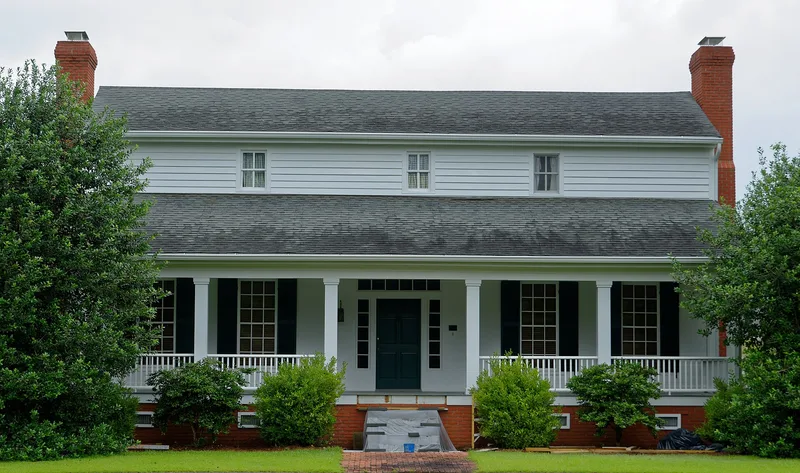
Built around 1834 by James Everett, an early settler and large landowner, this two-story house in Fort Valley, Peach County, represents the Plantation Plain type once common across Georgia. It began as a one-story dogtrot with an open passage between two rooms; the passage was later enclosed. The house was moved less than 100 feet around 1912, then about two miles in 1982 to avoid demolition, onto land that had been part of the Everett property. Termites and neglect had damaged it, so the rehabilitation kept what historic material could be saved, including heart-pine floors, paneled doors, front windows and some mortise-and-tenon framing. The rear shed was rebuilt and a two-story addition was added. The house was listed for its architecture: it retains the two-story main block, rear shed, front porch and central-hall plan with two rooms on each side. It is described as one of the oldest buildings in Peach County and one of few surviving examples of its type in Georgia.
Significance in brief: The nomination argues the house is significant in architecture as a now fairly rare example of the Plantation Plain type common in Georgia in the early to mid-19th century. It keeps the type's exterior form, its central-hall plan and some original fabric such as heart-pine floors, paneling and doors. It is described as one of the oldest buildings in Peach County.
Machine-generated summary. This summary was generated by a language model from the official nomination document and has not been reviewed line by line by an editor. It may contain errors. Check the source document before relying on any detail. Source: nomination document (PDF) · National Archives catalog entry. NRHP reference 92001674, listed December 10, 1992. Summary generated October 2026 (model claude-sonnet-5-5, prompt v1.0-2026-10-29, confidence high).
Key facts
| Address | 220 Northwoods Dr., Fort Valley |
|---|---|
| County | Peach County |
| Listed | December 10, 1992 |
| Reference number | 92001674 |
| Resource type | Building |
| Period of significance | C. 1834 |
| Architect / builder | James Everett |
| Architectural style | Plantation Plain |
| Criteria |
|
| Areas of significance | Architecture |
| Level of significance | Local |
| Status (as stated in the nomination) | Rehabilitated in 1982 after termite damage and neglect; still in use as a single dwelling. |
| Acreage | 5.6 |
| Coordinates | 32.59689, -83.89169 (NPS GIS) |
What listing means for this property
National Register listing is honorary for a privately owned home: it does not by itself restrict what an owner may do with their own money, and it does not require public access. Restrictions come from local landmark or historic-district ordinances, which are separate (how they differ).
Owner-occupied houses are not eligible for the 20% federal rehabilitation tax credit, which applies to income-producing buildings, but many states offer credits for homeowners. Listing also opens the door to preservation easements and to buying a plaque. Start with what listing means for homeowners, renovating a listed house and selling one.
General information, not legal or tax advice. Rules change; confirm with your State Historic Preservation Office or a qualified adviser.
Sources and further reading
- National Park Service, National Register of Historic Places database (snapshot May 2026), reference 92001674.
- Nomination form (PDF, National Archives) — catalog entry
- Wikidata Q134440926
- This listing as JSON
Last updated October 2026. Found an error? See the editorial policy for how to report it.