Lion House
Also known as: The Hoxey-Cargill House

Why it's listed
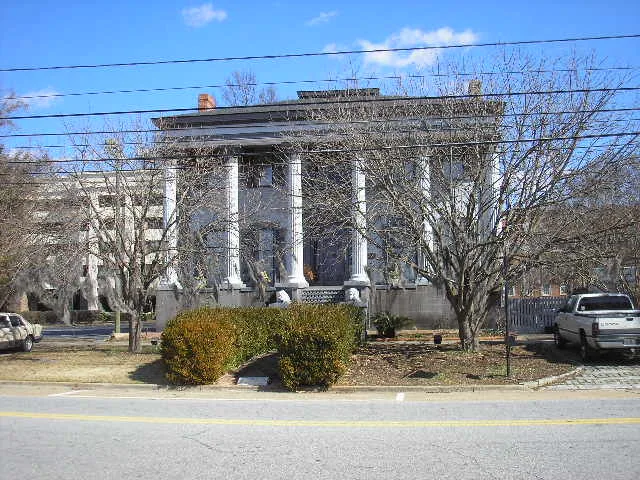
Two Nubian lions, one asleep and one awake, flank the front steps of this Columbus house at 1316 Third Avenue, giving it the name Lion House. Built in the 1840s for physician Dr. Thomas Hoxey and designed by Philadelphia architect Stephen Button, it is a temple-like, two-story building that blends Egyptian motifs with Greek Revival design. Tall Corinthian-style columns with lotus-leaf capitals, a flying balcony, and anthemion and honeysuckle carving mark the exterior and entrance. Inside, hall doorways carry lotus designs, and a sealed basement door once led to a tunnel toward the Chattahoochee River. Hoxey was a physician, soldier and founder of the Lyceum Society in 1839. During Wilson's Raid, mules and provisions were reportedly hidden in the basement. Later owners included Augustus Allen, suffragist organizer Emily MacDougald, and the deLaunay-Worsley family. The house is valued as one of the few downtown Great Houses and for its design, which is considered unique locally.
Significance in brief: The house is an unusual Egyptian variation of Greek Revival architecture, described as unique in the area and distinctive for its design by S.D. Button. It is one of the few remaining downtown 'Great Houses' and is tied to Dr. Hoxey, a Columbus physician and Lyceum Society founder, and to later owners including a noted Georgia suffragist organizer.
Machine-generated summary. This summary was generated by a language model from the official nomination document and has not been reviewed line by line by an editor. It may contain errors. Check the source document before relying on any detail. Source: nomination document (PDF) · National Archives catalog entry. NRHP reference 72000391, listed January 20, 1972. Summary generated October 2026 (model claude-sonnet-5-5, prompt v1.0-2026-10-29, confidence medium).
Key facts
| Address | 1316 3rd Ave., Columbus |
|---|---|
| County | Muscogee County |
| Listed | January 20, 1972 |
| Reference number | 72000391 |
| Resource type | Building |
| Period of significance | 1840's |
| Architect / builder | Stephen (S.D.) Button, Philadelphia architect; built for Dr. Thomas Hoxey |
| Architectural style | Egyptian variation of Greek Revival |
| Areas of significance | Architecture, Social History |
| Level of significance | National |
| Status (as stated in the nomination) | Listed as in good condition and altered, on its original site; marked as occupied and used as a private residence and commercial space. The nomination notes it sits on prime downtown commercial property next to a large furniture store. |
| Acreage | 0.2 |
| Within district | High Uptown Historic District |
| Coordinates | 32.47136, -84.98928 (NPS GIS) |
What listing means for this property
National Register listing is honorary for a privately owned home: it does not by itself restrict what an owner may do with their own money, and it does not require public access. Restrictions come from local landmark or historic-district ordinances, which are separate (how they differ).
Owner-occupied houses are not eligible for the 20% federal rehabilitation tax credit, which applies to income-producing buildings, but many states offer credits for homeowners. Listing also opens the door to preservation easements and to buying a plaque. Start with what listing means for homeowners, renovating a listed house and selling one.
General information, not legal or tax advice. Rules change; confirm with your State Historic Preservation Office or a qualified adviser.
Sources and further reading
- National Park Service, National Register of Historic Places database (snapshot May 2026), reference 72000391.
- Nomination form (PDF, National Archives) — catalog entry
- Wikipedia article (used for cross-checking only; text not reproduced here)
- Wikidata Q97704114
- This listing as JSON
Last updated October 2026. Found an error? See the editorial policy for how to report it.