Carter and Bradley, Cotton Factors and Warehouseman
Also known as: W. C. Bradley

Why it's listed
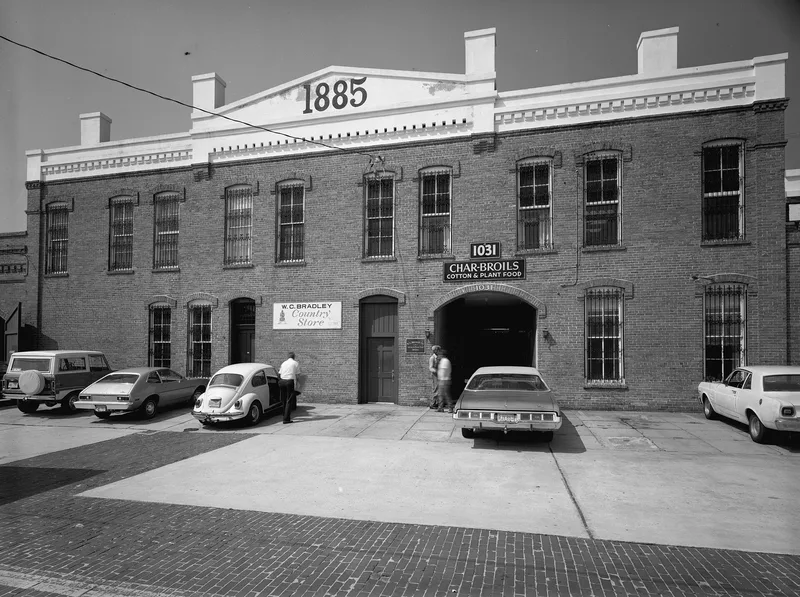
Along Front Avenue in Columbus, Georgia, a row of two-story brick warehouses recalls the city's cotton trade. Union troops destroyed the original cotton warehouses on these two blocks on April 17, 1865, in a fire that consumed between 50,000 and 100,000 bales of cotton. The buildings were rebuilt in the late 1860s and expanded in later decades, with additions dating from about 1870 to 1930. Paired arched windows with brick hood moulding, arched doors, a raised central parapet pediment and simple brick patterns along the roofline give the structures their late Victorian character. A south wing has a gallery with five wide arched openings. The W.C. Bradley Company began in a section of the complex in 1883 and eventually came to own both blocks. It became one of the city's largest industries, and the warehouses continue to store cotton, with some interior space converted to offices. Original company advertising graphics survive on the Bay Avenue side.
Significance in brief: The warehouses are significant for housing the W.C. Bradley Company, one of Columbus' largest industries, for nearly 100 years. They are also considered a fine example of late Victorian warehouse construction, with functional buildings enhanced by ornamental brickwork on window lintels and parapets.
Machine-generated summary. This summary was generated by a language model from the official nomination document and has not been reviewed line by line by an editor. It may contain errors. Check the source document before relying on any detail. Source: nomination document (PDF) · National Archives catalog entry. NRHP reference 80001148, listed December 2, 1980. Summary generated October 2026 (model claude-sonnet-5-5, prompt v1.0-2026-10-29, confidence medium).
Key facts
| Address | 1001--1037 Front Ave., Columbus |
|---|---|
| County | Muscogee County |
| Listed | December 2, 1980 |
| Reference number | 80001148 |
| Resource type | Building |
| Architectural style | Industrial-Commercial; late Victorian warehouse construction with Second Empire type windows |
| Areas of significance | Industry, Architecture |
| Level of significance | Local |
| Status (as stated in the nomination) | Still used as cotton warehouses, with some interior space converted to offices; described as well maintained and surrounded by commercial, industrial and warehouse uses. |
| Acreage | 1.2 |
| Coordinates | 32.46568, -84.99504 (NPS GIS) |
What listing means for this property
National Register listing is honorary: it recognises significance and does not restrict what a private owner may do without federal money or permits. It unlocks the 20% federal rehabilitation tax credit for income-producing buildings, state credits in many states, and Section 106 review when federal agencies are involved. See what listing means in practice.
General information, not legal or tax advice. Rules change; confirm with your State Historic Preservation Office or a qualified adviser.
Sources and further reading
- National Park Service, National Register of Historic Places database (snapshot May 2026), reference 80001148.
- Nomination form (PDF, National Archives) — catalog entry
- Wikidata Q134401004
- This listing as JSON
Last updated October 2026. Found an error? See the editorial policy for how to report it.