Evergreen Congregational Church and School

Why it's listed
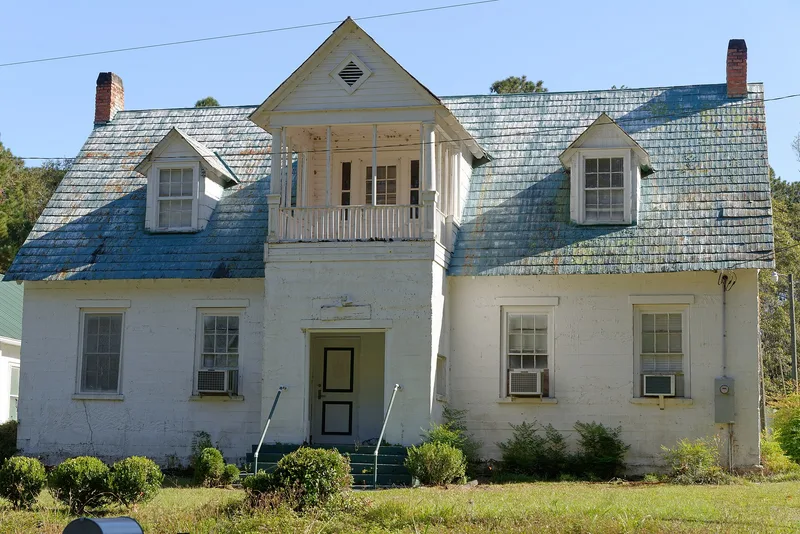
Evergreen Congregational Church and School is a two-building complex on two acres along Meridian Road in Beachton, a rural African-American community in southwest Georgia. The school, built in 1911 of poured concrete, has classrooms downstairs and teachers' bedrooms upstairs. Architect James E. Wright, a congregation member, designed it, and its rough concrete finish reflects work by church members. The concrete-block church, finished in 1928, has a gabled porch and cupola, and a rear annex was added around 1990. Founded in 1903 with the American Missionary Association, the congregation ran the first school for Black children in the area. Later the county shared responsibility for it as the Grady County Training School. After 1938 the school building served as a community hall for voter registration drives and farm and youth programs. Andrew Young, later a civil rights leader, United Nations ambassador and Atlanta mayor, served as pastor from 1957 to 1959. Both buildings are still used by the congregation.
Significance in brief: The nomination argues the complex was the religious and civic center of Beachton's Black community and a rare surviving Congregational church and school established through the American Missionary Association. It is also tied to Andrew Young, who held his first pastorate there from 1957 to 1959. The school is highlighted as an intact example of poured-concrete construction by congregation members.
Machine-generated summary. This summary was generated by a language model from the official nomination document and has not been reviewed line by line by an editor. It may contain errors. Check the source document before relying on any detail. Source: nomination document (PDF) · National Archives catalog entry. NRHP reference 02001260, listed October 31, 2002. Summary generated October 2026 (model claude-sonnet-5-5, prompt v1.0-2026-10-29, confidence high).
Key facts
| Address | 497 Meridian Rd., Beachton |
|---|---|
| County | Grady County |
| Listed | October 31, 2002 |
| Reference number | 02001260 |
| Resource type | Building |
| Period of significance | c.1911-1959 |
| Architect / builder | James E. Wright (architect) |
| Architectural style | No style |
| Criteria |
|
| Areas of significance | Black, Religion, Education, Architecture |
| Level of significance | State, Local |
| Status (as stated in the nomination) | Both buildings remain in use: the church as a place of worship and the school as the church's fellowship hall and recreation center. |
| Acreage | 2 |
| Coordinates | 30.72804, -84.13682 (NPS GIS) |
What listing means for this property
Religious properties are listed for their architectural or historical significance, not their religious use. Listing is honorary and does not restrict the congregation's use of the building. The federal rehabilitation credit is generally unavailable unless part of the building is income-producing; some state programmes and preservation grants do cover religious buildings. Federal funding or permits trigger Section 106 review.
General information, not legal or tax advice. Rules change; confirm with your State Historic Preservation Office or a qualified adviser.
Sources and further reading
- National Park Service, National Register of Historic Places database (snapshot May 2026), reference 02001260.
- Nomination form (PDF, National Archives) — catalog entry
- Wikipedia article (used for cross-checking only; text not reproduced here)
- Wikidata Q14686628
- This listing as JSON
Last updated October 2026. Found an error? See the editorial policy for how to report it.