Fox Theatre
Also known as: See Also:Fox Theatre Historic District

Why it's listed
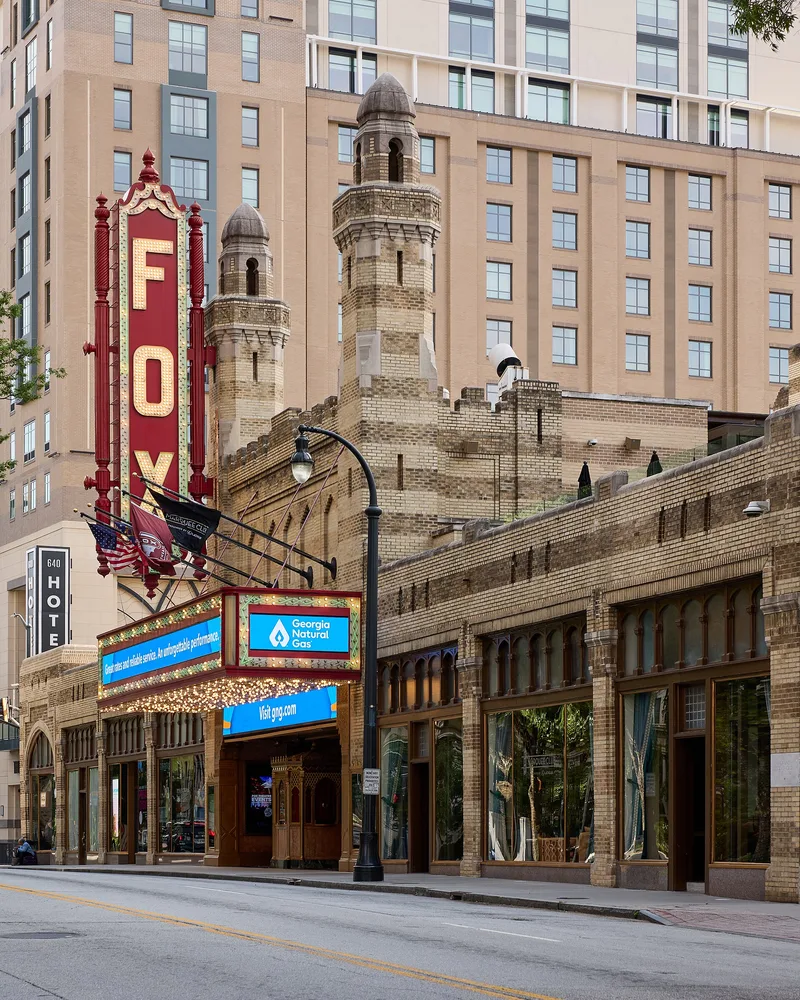
Occupying an entire block on Peachtree Street in Atlanta, the Fox Theater is a movie palace designed in 1927 by the firm of Marye, Alger and Vinour and opened on Christmas Day, 1929. It began as a planned Shriners' mosque for the Yaarab Temple, then grew to include shops and a theater auditorium at the suggestion of film magnate William Fox. Its eclectic Mideastern design mixes Islamic, Egyptian, Nubian and Arabic motifs, with minarets, onion domes, horseshoe arches and bands of cream and buff brick outside. Inside, the auditorium resembles a fortified courtyard under a ceiling of crystal stars and projected clouds. Plaster craftsmen created the simulated wood and stone finishes. The building also holds a large Moller organ, extensive backstage space and acoustics praised by the Metropolitan Opera. The nomination presents it as an outstanding theater and architectural example that outlasted many other movie palaces, though it notes that its future was uncertain.
Significance in brief: The nomination calls it one of the most prodigious 20th-century structures in Georgia, both as a theater and as an example of Neo-Mideastern Eclectic architecture. It highlights the design's completeness, its mechanical systems, its acoustics and its large Moller organ. It also notes that the building survived the end of the golden age of the movie palace.
Machine-generated summary. This summary was generated by a language model from the official nomination document and has not been reviewed line by line by an editor. It may contain errors. Check the source document before relying on any detail. Source: nomination document (PDF) · National Archives catalog entry. NRHP reference 74002230, listed May 17, 1974. Summary generated October 2026 (model claude-sonnet-5-5, prompt v1.0-2026-10-29, confidence high).
Key facts
| Address | 600 Peachtree St., Atlanta |
|---|---|
| County | Fulton County |
| Listed | May 17, 1974 |
| Reference number | 74002230 |
| Resource type | Building |
| Period of significance | 20th Century; specific date 1929 |
| Architect / builder | Marye, Alger and Vinour (P. Thornton Marye, Richard W. Alger, Ollivier J. Vinour; Vinour was main designer) |
| Architectural style | Neo-Mideastern Eclectic Style |
| Areas of significance | Architecture, Performing Arts |
| Level of significance | National |
| National Historic Landmark | Yes, designated May 11, 1976 |
| Status (as stated in the nomination) | Described as in good condition and still in use as a theater/entertainment venue, with the Egyptian Ballroom used as a ballet studio and offices. The nomination warns that its longevity is endangered because it is held only on yearly lease in a prime downtown location. |
| Acreage | 2 |
| Coordinates | 33.77236, -84.38655 (NPS GIS) |
What listing means for this property
For an income-producing building, listing (individually or as a contributing building in a district) is the gateway to the 20% federal rehabilitation tax credit on qualified rehabilitation costs, often stackable with state credits. Work claiming the credit must follow the Secretary of the Interior's Standards and be approved in advance.
Listing does not restrict a private owner acting without federal money or permits; where federal funding or licensing is involved, Section 106 review applies.
General information, not legal or tax advice. Rules change; confirm with your State Historic Preservation Office or a qualified adviser.
Sources and further reading
- National Park Service, National Register of Historic Places database (snapshot May 2026), reference 74002230.
- Nomination form (PDF, National Archives) — catalog entry
- Wikipedia article (used for cross-checking only; text not reproduced here)
- Wikidata Q1440190
- This listing as JSON
Last updated October 2026. Found an error? See the editorial policy for how to report it.