Adair Park Historic District
Adair Park Historic District is a historic district in Atlanta, Fulton County, Georgia, listed on the National Register of Historic Places on June 2, 2000 (reference number 00000563). The National Park Service records its significance in Architecture and Community Planning and Development at the local level.
Facts from the NPS National Register database (); nomination summary October 2026. Last updated . Sources for each fact.

The pin is a point inside the NPS boundary polygon, not a surveyed location.
Why it's listed
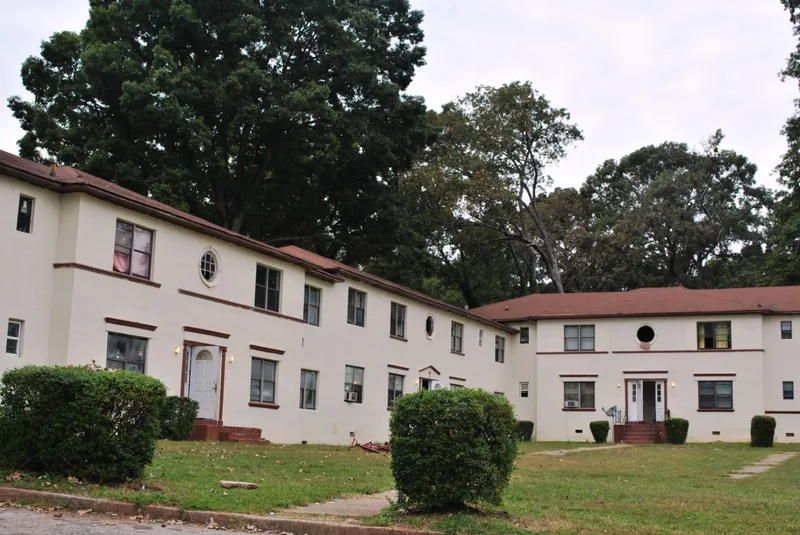
Adair Park is a residential neighborhood of about 19 blocks southwest of downtown Atlanta, next to the Norfolk Southern railroad tracks. It grew between the 1890s and 1940s as a streetcar suburb, with a streetcar line extended into the area in 1902. Most of its houses are one-story wood or brick bungalows with Craftsman detailing, set close together on long, narrow, uniform lots along a grid of streets, with a curving section at the south end. Other house types include Queen Anne, gabled-ell and New South cottages, plus the two-story brick Gillette Mansion begun around 1892. Community landmarks include the 1912 George W. Adair School by Edward E. Dougherty, with a 1928 auditorium by G. Lloyd Preacher, the 1921 Stewart Avenue Methodist church, the 1947 Adair Park Baptist Church and the 1922 park. The district was recognized for its architecture and as an intact example of a bungalow suburb, with a period of significance of c.1892 to 1947.
Significance in brief: The district is significant in architecture for its variety of late 19th and early 20th century house types and styles, led by the Craftsman bungalow, and for its landmark school and churches. It is significant in community planning and development as a classic streetcar-era bungalow suburb with grid-patterned streets, uniform lots and a park. It retains its historic development pattern.
Machine-generated summary. This summary was generated by a language model from the official nomination document and has not been reviewed line by line by an editor. It may contain errors. Check the source document before relying on any detail. Source: nomination document (PDF) · National Archives catalog entry. NRHP reference 00000563, listed June 2, 2000. Summary generated October 2026 (model claude-sonnet-5-5, prompt v1.0-2026-10-29, confidence high).
Key facts
| Official database NPS National Register database, ref. 00000563 , checked | |
|---|---|
| Address | Bounded by Metropolitan Pkwy., Lexington Ave., Norfolk Southern RR and Shelton Ave., Atlanta |
| County | Fulton County |
| Listed | June 2, 2000 |
| Reference number | 00000563 |
| Resource type | District |
| Areas of significance | Architecture, Community Planning and Development |
| Level of significance | Local |
| National Historic Landmark | No |
| Acreage | 136 |
| Official document, machine-extracted Nomination form (National Archives) , checked | |
| Period of significance | c.1892-1947 |
| Architect / builder | Reverend Charles Lipham; Edward E. Dougherty; G. Lloyd Preacher |
| Architectural style | Queen Anne, Late Gothic Revival, Bungalow/Craftsman, Folk Victorian, English Vernacular Revival |
| Criteria |
|
| Status (as stated in the nomination) | Current functions include single and multiple dwellings, commerce, education, religious facilities and a park. The Adair Park Baptist Church building is now used by another congregation. |
| Official dataset NPS cultural-resource GIS (NRHP locations) | |
| Coordinates | 33.73106, -84.40945 |
What listing means for this property
This is a historic district. Buildings within its boundary are either contributing (they add to the district's significance) or non-contributing. Owners of contributing income-producing buildings can claim the 20% federal rehabilitation tax credit; homeowners should look at state credits. National Register districts impose no design review by themselves; a local historic district ordinance, if one exists, does (the difference explained).
General information, not legal or tax advice. Rules change; confirm with your State Historic Preservation Office or a qualified adviser.
Questions about Adair Park Historic District
When was Adair Park Historic District added to the National Register of Historic Places?
Adair Park Historic District was listed on June 2, 2000. Its National Register reference number is 00000563.
Is Adair Park Historic District a National Historic Landmark?
No. The National Park Service database (snapshot of May 2026) lists Adair Park Historic District on the National Register but does not record it as a National Historic Landmark.
Where is Adair Park Historic District?
Bounded by Metropolitan Pkwy., Lexington Ave., Norfolk Southern RR and Shelton Ave., Atlanta, Fulton County, Georgia; coordinates 33.73106, -84.40945.
Why is Adair Park Historic District historically significant?
According to a machine-generated summary of its nomination form: The district is significant in architecture for its variety of late 19th and early 20th century house types and styles, led by the Craftsman bungalow, and for its landmark school and churches. It is significant in community planning and development as a classic streetcar-era bungalow suburb with grid-patterned streets, uniform lots and a park. It retains its historic development pattern. Check the nomination document before relying on any detail.
Who designed or built Adair Park Historic District?
The nomination form names Reverend Charles Lipham; Edward E. Dougherty; G. Lloyd Preacher as architect or builder (extracted by machine from the nomination; check the source document).
Where can I read the original nomination for Adair Park Historic District?
The nomination form is a public record held by the National Archives: nomination document (PDF).
Sources and further reading
- National Park Service, National Register of Historic Places database (snapshot May 2026), reference 00000563.
- Nomination form (PDF, National Archives) — catalog entry
- Wikidata Q141758304
- This listing as JSON
Last updated October 2026. Found an error? See the editorial policy for how to report it.