Strange-Duncan House

Why it's listed
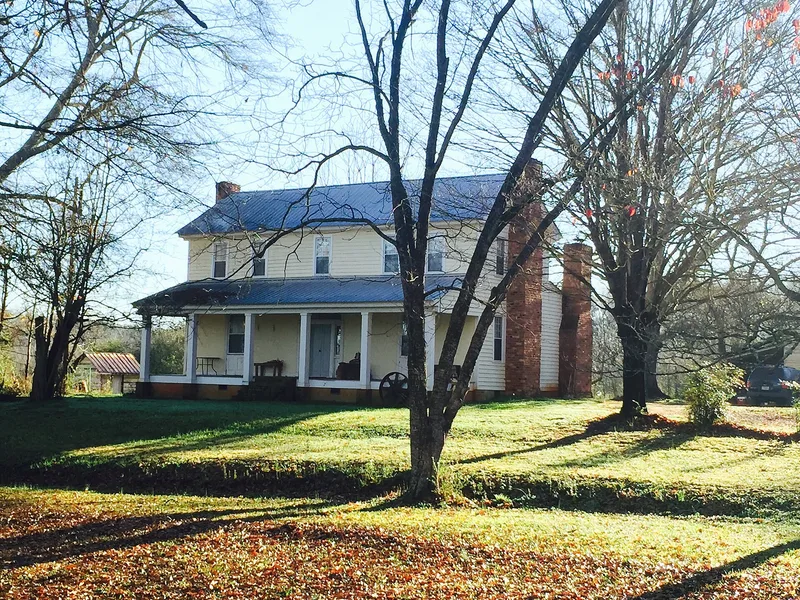
Built around 1820 by Seth Strange with enslaved labor, this two-story farmhouse on Georgia State Route 51 near Carnesville is a Plantation Plain house with a front shed porch, rear shed rooms, a standing seam metal roof and chimneys at both gable ends. Reeded trim, bull's eye corner blocks and dentil work survive on the exterior. The property also includes a barn, a wood shed and the Strange family cemetery. Strange became a prosperous farmer who owned slaves, which was unusual in the area, and grew cotton as a cash crop on a farm larger than most nearby. John Duncan bought the farm in 1863 and kept it productive until his death in 1890. W. H. T. Gillespie then acquired it and used the house for tenants. It was recognized for its architecture and as a representative farm complex along the Old Federal Road, with a period of significance ending in 1946.
Significance in brief: It is argued to be significant in architecture as a good early-19th-century example of the Plantation Plain house type, and in agriculture as a typical farm complex along the Old Federal Road. The farm was larger than most in the area and grew cotton as a cash crop. Its owners included Seth Strange, John Duncan and later W. H. T. Gillespie, who used the house as tenant housing.
Machine-generated summary. This summary was generated by a language model from the official nomination document and has not been reviewed line by line by an editor. It may contain errors. Check the source document before relying on any detail. Source: nomination document (PDF) · National Archives catalog entry. NRHP reference 96001298, listed November 7, 1996. Summary generated October 2026 (model claude-sonnet-5-5, prompt v1.0-2026-10-29, confidence high).
Key facts
| Address | GA 51, approximately .75 mi. E of the Franklin--Banks County line, Carnesville |
|---|---|
| County | Franklin County |
| Listed | November 7, 1996 |
| Reference number | 96001298 |
| Resource type | Building |
| Period of significance | C. 1820-1946 |
| Architect / builder | Seth Strange |
| Architectural style | OTHER: Plantation Plain |
| Criteria |
|
| Areas of significance | Architecture, Agriculture |
| Level of significance | Local |
| Status (as stated in the nomination) | Still used as a single dwelling; the house has some altered interior finishes, a c. 1960 remodeled rear shed, and replacement doors and clapboards. |
| Acreage | 15 |
| Coordinates | 34.37124, -83.37993 (NPS GIS) |
What listing means for this property
National Register listing is honorary for a privately owned home: it does not by itself restrict what an owner may do with their own money, and it does not require public access. Restrictions come from local landmark or historic-district ordinances, which are separate (how they differ).
Owner-occupied houses are not eligible for the 20% federal rehabilitation tax credit, which applies to income-producing buildings, but many states offer credits for homeowners. Listing also opens the door to preservation easements and to buying a plaque. Start with what listing means for homeowners, renovating a listed house and selling one.
General information, not legal or tax advice. Rules change; confirm with your State Historic Preservation Office or a qualified adviser.
Sources and further reading
- National Park Service, National Register of Historic Places database (snapshot May 2026), reference 96001298.
- Nomination form (PDF, National Archives) — catalog entry
- Wikidata Q134305105
- This listing as JSON
Last updated October 2026. Found an error? See the editorial policy for how to report it.