Nails Creek Historic District

Why it's listed
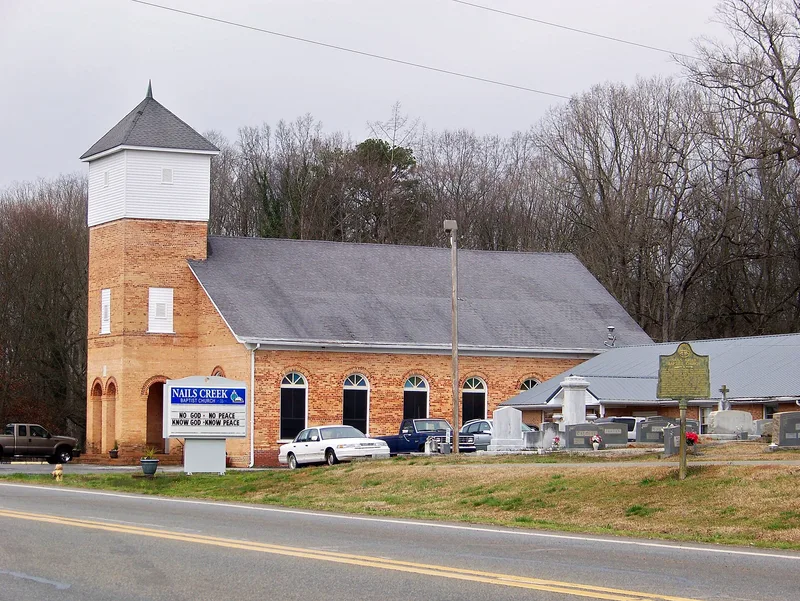
Nails Creek is a rural crossroads community along the Old Federal Road in Banks County, Georgia, also once known as Jewellville. Its focal point is the Nails Creek Baptist Church, organized in 1787, whose present Romanesque Revival brick building dates from 1908. The district also includes two stores, one of which housed a post office, a tenant house, a cemetery, and the William Wiley House, a Gothic Revival-influenced farmhouse built around 1870 with several well-preserved outbuildings. The Wiley family settled the area around 1800 and operated stores and served as postmasters, shaping the community's growth. About 100 people lived there in the early 1880s, but the settlement declined rapidly in the 1920s and 1930s. The district was listed for its architecture, its small north Georgia farm complexes, and its development as a typical crossroads settlement, with a period of significance from about 1864 to 1946.
Significance in brief: The district is argued to be significant in architecture, agriculture, and community planning and development as a representative crossroads community of mid-19th century northeast Georgia. Its farmhouse, outbuildings, church and stores show local craftsmanship and materials typical of the period. The Wiley family shaped its growth as farmers, store operators and postmasters.
Machine-generated summary. This summary was generated by a language model from the official nomination document and has not been reviewed line by line by an editor. It may contain errors. Check the source document before relying on any detail. Source: nomination document (PDF) · National Archives catalog entry. NRHP reference 96001307, listed November 7, 1996. Summary generated October 2026 (model claude-sonnet-5-5, prompt v1.0-2026-10-29, confidence high).
Key facts
| Address | Jct. of GA 51 and GA 59, Carnesville |
|---|---|
| County | Banks County |
| Listed | November 7, 1996 |
| Reference number | 96001307 |
| Resource type | District |
| Period of significance | C. 1864-1946 |
| Architect / builder | Local African-American craftsman; Mr. Thompson - plaster work |
| Architectural style | Late Victorian/Romanesque Revival; Late Victorian/Gothic Revival; Gable-Ell; Georgian plan |
| Criteria |
|
| Areas of significance | Architecture, Community Planning and Development |
| Level of significance | Local |
| Status (as stated in the nomination) | Current functions include single dwellings, a religious facility and a cemetery; the service station/store on the tenant house property is not presently used. |
| Acreage | 100 |
| Coordinates | 34.36340, -83.40061 (NPS GIS) |
What listing means for this property
This is a historic district. Buildings within its boundary are either contributing (they add to the district's significance) or non-contributing. Owners of contributing income-producing buildings can claim the 20% federal rehabilitation tax credit; homeowners should look at state credits. National Register districts impose no design review by themselves; a local historic district ordinance, if one exists, does (the difference explained).
General information, not legal or tax advice. Rules change; confirm with your State Historic Preservation Office or a qualified adviser.
Sources and further reading
- National Park Service, National Register of Historic Places database (snapshot May 2026), reference 96001307.
- Nomination form (PDF, National Archives) — catalog entry
- Wikidata Q141700499
- This listing as JSON
Last updated October 2026. Found an error? See the editorial policy for how to report it.