Moultrie Commercial Historic District

Why it's listed
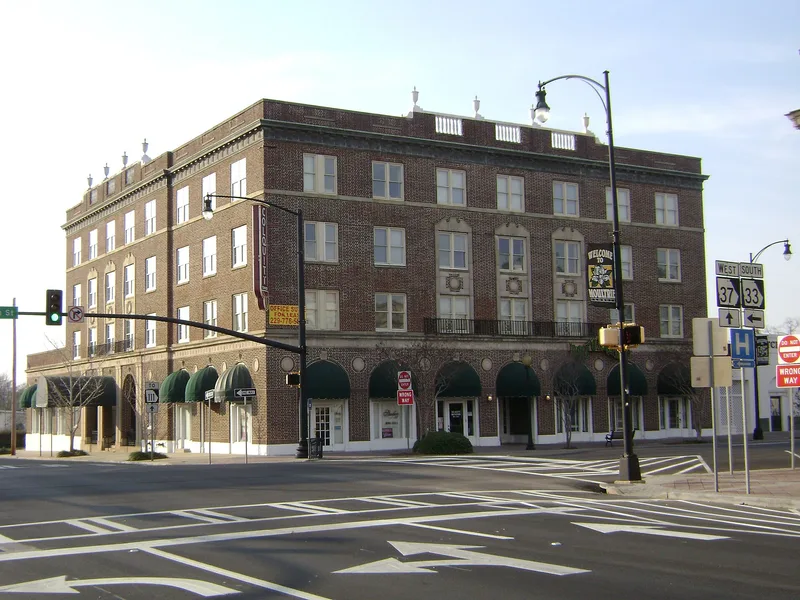
Downtown Moultrie's commercial core is a compact grid of brick storefronts centered on the Colquitt County courthouse square. The settlement began in 1859 at the crossroads of two early roads, and the district includes 61 contributing resources along with a few industrial and railroad-related buildings, such as the depot and People's Warehouse, just beyond the core. Most buildings are one or two stories, with shared party walls and decorative brick cornices. Several freestanding landmarks add variety: the 1902 Neoclassical Revival courthouse, the 1908 Colonial Revival Carnegie Library, the castellated 1915 jail, the 1917 Federal Building, a Beaux Arts bank, and Art Deco buildings including the Colquitt Theater. The district was listed for its architecture and for what it shows about local commerce and transportation. After the railroad arrived in 1893, Moultrie grew into a regional trade center supported by turpentine, lumber, textile and meat packing industries. The surviving buildings still convey that period of growth, which lasted from the turn of the century to the late 1930s.
Significance in brief: The district is significant in architecture for its concentration of brick commercial row buildings and its range of early 20th-century styles. It is also significant in commerce, community planning, politics/government and transportation, reflecting Moultrie's growth as a county seat and trade center after the railroad arrived in 1893.
Machine-generated summary. This summary was generated by a language model from the official nomination document and has not been reviewed line by line by an editor. It may contain errors. Check the source document before relying on any detail. Source: nomination document (PDF) · National Archives catalog entry. NRHP reference 94000543, listed June 3, 1994. Summary generated October 2026 (model claude-sonnet-5-5, prompt v1.0-2026-10-29, confidence medium).
Key facts
| Address | Roughly bounded by NE. First Ave., SE. Second Ave., W. First St. and E. Fourth St., Moultrie |
|---|---|
| County | Colquitt County |
| Listed | June 3, 1994 |
| Reference number | 94000543 |
| Resource type | District |
| Period of significance | 1859-1941 |
| Architect / builder | Courthouse (1902): A. J. Bryan and Company, architect; J. H. Harris and G. W. Milligan, builders. Carnegie Library (1908): T.F. Lockwood, architect; G.W. Milligan, Cement Construction Company, builder. Jail (1915): Southern Structural Steel Company, San Antonio, Texas. Federal Building (1917): James A. Wetmore, Supervising Architect. |
| Architectural style | Beaux Arts, Neoclassical Revival, Colonial Revival, Craftsman/Mediterranean Revival, Art Deco, Commercial Vernacular Victorian, 20th Century Commercial, Stripped Classical |
| Criteria |
|
| Areas of significance | Transportation, Politics/Government, Community Planning and Development, Commerce, Architecture |
| Level of significance | Local |
| Status (as stated in the nomination) | Described as a thriving small-town commercial center whose historic integrity remains substantially intact despite alterations to many buildings; there are very few vacant lots. |
| Acreage | 48 |
| Coordinates | 31.18070, -83.78695 (NPS GIS) |
What listing means for this property
This is a historic district. Buildings within its boundary are either contributing (they add to the district's significance) or non-contributing. Owners of contributing income-producing buildings can claim the 20% federal rehabilitation tax credit; homeowners should look at state credits. National Register districts impose no design review by themselves; a local historic district ordinance, if one exists, does (the difference explained).
General information, not legal or tax advice. Rules change; confirm with your State Historic Preservation Office or a qualified adviser.
Sources and further reading
- National Park Service, National Register of Historic Places database (snapshot May 2026), reference 94000543.
- Nomination form (PDF, National Archives) — catalog entry
- Wikipedia article (used for cross-checking only; text not reproduced here)
- Wikidata Q30623243
- This listing as JSON
Last updated October 2026. Found an error? See the editorial policy for how to report it.