Reese Street Historic District

Why it's listed
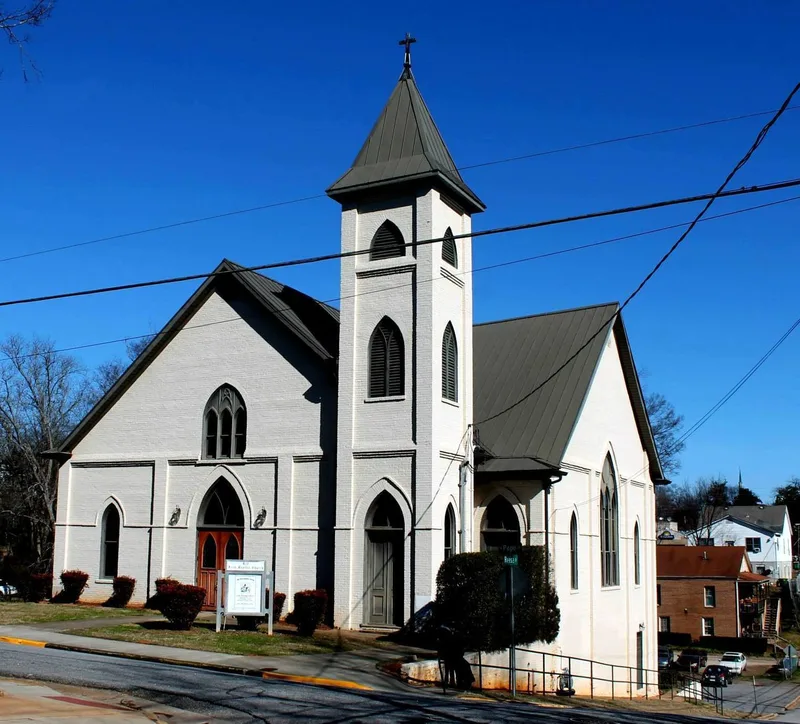
Reese Street Historic District is an 18-acre neighborhood west of downtown Athens, Georgia, developed from the 1860s as a home for the city's Black residents. Its small lots hold mostly one-story, wood-framed vernacular houses, including shotgun, saddlebag and bungalow types, along with Hill's First Baptist Church, the 1913 Athens High and Industrial School and a few brick commercial buildings. Doctors, dentists, educators, tradesmen and laborers all lived here, with larger homes on the higher, level sites and modest houses on the steeper ground. The hilly land had been overlooked by white settlement, a pattern the nomination links to Black neighborhoods across Georgia. The district was also an education center. Knox School, founded in 1868, was the city's first school for Black students, and the Athens High and Industrial School was Georgia's only Black public high school in 1916. It was listed for its Black history, community development, education and architecture.
Significance in brief: The district is described as one of the most intact Black neighborhoods in Georgia and one of only two identified in Athens. It documents the residential patterns, community planning, education and vernacular architecture of Athens' Black community. It meets Criteria A and C.
Machine-generated summary. This summary was generated by a language model from the official nomination document and has not been reviewed line by line by an editor. It may contain errors. Check the source document before relying on any detail. Source: nomination document (PDF) · National Archives catalog entry. NRHP reference 87001990, listed November 10, 1987. Summary generated October 2026 (model claude-sonnet-5-5, prompt v1.0-2026-10-29, confidence high).
Key facts
| Address | Roughly bounded by Meigs, Finley, Broad, & Harris Sts., Athens |
|---|---|
| County | Clarke County |
| Listed | November 10, 1987 |
| Reference number | 87001990 |
| Resource type | District |
| Period of significance | 1868-1930 |
| Architect / builder | several |
| Architectural style | Vernacular residential forms (saddlebag, shotgun, L-shaped cottage, pyramidal-roof square plan) with Victorian Eclectic, Queen Anne, Greek Revival, Neoclassical and Craftsman details |
| Criteria |
|
| Areas of significance | Community Planning and Development, Black, Education, Architecture |
| Level of significance | State |
| Status (as stated in the nomination) | Listed as occupied; present uses include private residence, commercial, educational and religious. Two lots that once held schools are vacant. |
| Acreage | 18 |
| Coordinates | 33.95778, -83.38468 (NPS GIS) |
What listing means for this property
This is a historic district. Buildings within its boundary are either contributing (they add to the district's significance) or non-contributing. Owners of contributing income-producing buildings can claim the 20% federal rehabilitation tax credit; homeowners should look at state credits. National Register districts impose no design review by themselves; a local historic district ordinance, if one exists, does (the difference explained).
General information, not legal or tax advice. Rules change; confirm with your State Historic Preservation Office or a qualified adviser.
Sources and further reading
- National Park Service, National Register of Historic Places database (snapshot May 2026), reference 87001990.
- Nomination form (PDF, National Archives) — catalog entry
- Wikidata Q49549134
- This listing as JSON
Last updated October 2026. Found an error? See the editorial policy for how to report it.