Boulevard Historic District
Also known as: See Also:President's House, University of Georgia; Grady, Hen
Boulevard Historic District is a historic district in Athens, Clarke County, Georgia, listed on the National Register of Historic Places on April 18, 1985 (reference number 85000851). The National Park Service records its significance in Community Planning and Development, Landscape Architecture, Transportation, Politics/Government and Architecture at the local level.
Facts from the NPS National Register database (); nomination summary October 2026. Last updated . Sources for each fact.

The pin is a point inside the NPS boundary polygon, not a surveyed location.
Why it's listed
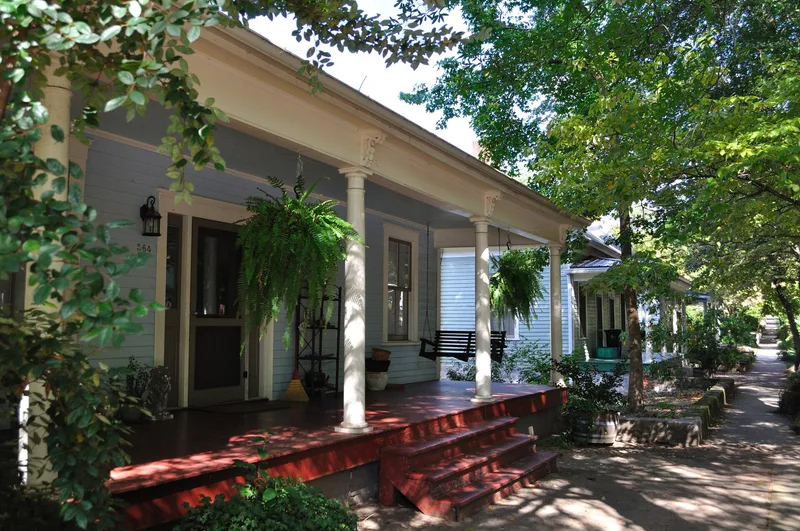
Boulevard Historic District is a residential neighborhood in Athens, Georgia, that grew as a streetcar suburb. Planning began in 1890, when a group of private developers, the Athens Park and Improvement Company, laid out the area. A streetcar line down Boulevard connected it with downtown. The suburb was formed from the landholdings of three Greek Revival mansions built between 1835 and 1856 along Prince Avenue. Houses range from simple vernacular cottages to large mansions, mostly of wood, in Victorian Eclectic, Foursquare, Neoclassical and Bungalow styles. A mill village at the northwest corner housed workers for the Southern Manufacturing Company. Yards are informally planted, and some original street trees survive despite a 1973 tornado. The district is also linked to Howell Cobb, a governor and Treasury Secretary, and Benjamin Harvey Hill, a congressman and senator. Later documentation set its period of significance at 1835 to 1930, when development was essentially complete.
Significance in brief: The district is significant for community planning and transportation as a late 19th-century streetcar suburb built by private investors. It is also significant for its range of 19th- and early 20th-century houses, its informal and formal landscaping, and its association with prominent politicians such as Howell Cobb and Benjamin Harvey Hill.
Machine-generated summary. This summary was generated by a language model from the official nomination document and has not been reviewed line by line by an editor. It may contain errors. Check the source document before relying on any detail. Source: nomination document (PDF) · National Archives catalog entry. NRHP reference 85000851, listed April 18, 1985. Summary generated October 2026 (model claude-sonnet-5-5, prompt v1.0-2026-10-29, confidence high).
Key facts
| Official database NPS National Register database, ref. 85000851 , checked | |
|---|---|
| Address | Roughly bounded by the Seaboard Coastline RR tracks, Pulaski St., Prince Ave., and Hiawassee St., Athens |
| County | Clarke County |
| Listed | April 18, 1985 |
| Reference number | 85000851 |
| Resource type | District |
| Areas of significance | Community Planning and Development, Landscape Architecture, Transportation, Politics/Government, Architecture |
| Level of significance | Local |
| National Historic Landmark | No |
| Acreage | 150 |
| Official document, machine-extracted Nomination form (National Archives) , checked | |
| Period of significance | 1835-1930 |
| Architect / builder | Multiple |
| Architectural style | Greek Revival, Victorian Eclectic, American Foursquare, Neoclassical, Bungalow |
| Status (as stated in the nomination) | Occupied; mostly private residences with some commercial, educational and religious uses. Intrusions include a few recent apartment buildings and commercial structures. |
| Official dataset NPS cultural-resource GIS (NRHP locations) | |
| Coordinates | 33.96632, -83.39103 |
What listing means for this property
This is a historic district. Buildings within its boundary are either contributing (they add to the district's significance) or non-contributing. Owners of contributing income-producing buildings can claim the 20% federal rehabilitation tax credit; homeowners should look at state credits. National Register districts impose no design review by themselves; a local historic district ordinance, if one exists, does (the difference explained).
General information, not legal or tax advice. Rules change; confirm with your State Historic Preservation Office or a qualified adviser.
Questions about Boulevard Historic District
When was Boulevard Historic District added to the National Register of Historic Places?
Boulevard Historic District was listed on April 18, 1985. Its National Register reference number is 85000851.
Is Boulevard Historic District a National Historic Landmark?
No. The National Park Service database (snapshot of May 2026) lists Boulevard Historic District on the National Register but does not record it as a National Historic Landmark.
Where is Boulevard Historic District?
Roughly bounded by the Seaboard Coastline RR tracks, Pulaski St., Prince Ave., and Hiawassee St., Athens, Clarke County, Georgia; coordinates 33.96632, -83.39103.
Why is Boulevard Historic District historically significant?
According to a machine-generated summary of its nomination form: The district is significant for community planning and transportation as a late 19th-century streetcar suburb built by private investors. It is also significant for its range of 19th- and early 20th-century houses, its informal and formal landscaping, and its association with prominent politicians such as Howell Cobb and Benjamin Harvey Hill. Check the nomination document before relying on any detail.
Who designed or built Boulevard Historic District?
The nomination form names Multiple as architect or builder (extracted by machine from the nomination; check the source document).
Where can I read the original nomination for Boulevard Historic District?
The nomination form is a public record held by the National Archives: nomination document (PDF).
Sources and further reading
- National Park Service, National Register of Historic Places database (snapshot May 2026), reference 85000851.
- Nomination form (PDF, National Archives) — catalog entry
- Wikidata Q34904125
- This listing as JSON
Last updated October 2026. Found an error? See the editorial policy for how to report it.