Collins-Odom-Strickland House
Also known as: Friendship House

Why it's listed
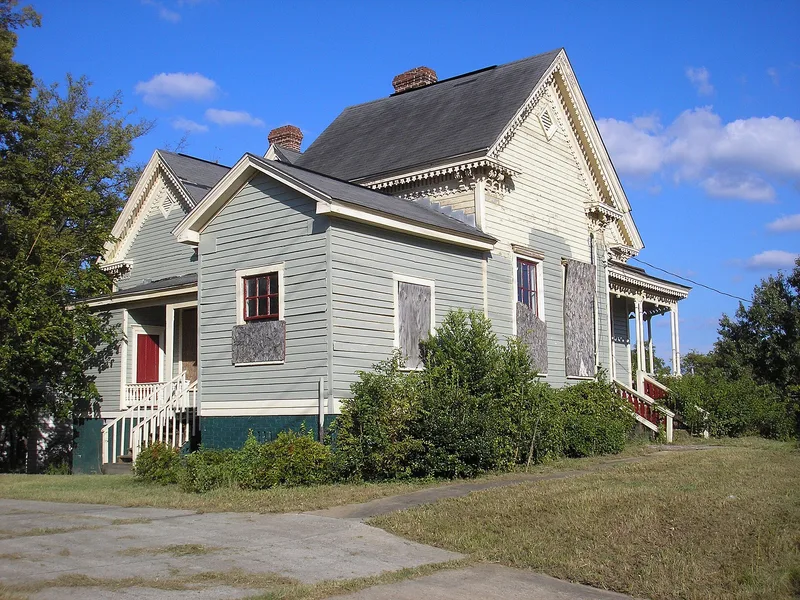
Built around 1880 at 1495 Second Street in Macon, this one-story Victorian cottage is noted for its asymmetrical massing, multiple gables, angled veranda and bay window. Elaborate hand-sawn ornament decorates the gables, porch columns, bay window and cornice, and the work remains intact. The house is framed in long leaf pine, with flush narrow weatherboards, ceilings about fifteen feet high and original fireplaces. A 1970 architectural survey of Macon by Carl Feiss and Russell Wright singled it out as one of the finest examples of the city's cottage styles. Its history is tied to the railroads: Andrew J. Collins, a railroad conductor, bought the lot in 1879, and later owners and tenants included yard workers, a locomotive engineer and clerks of railway-related firms. It illustrates the kind of affordable housing used by middle-class railroad employees near their work. Since 1973 it has operated as Friendship House, a community center for social rehabilitation programs.
Significance in brief: The nomination calls it primarily architecturally significant as an exceptionally good example of picturesque carpenter Victorian architecture, with intact hand-sawn ornament. A 1970 Macon survey by Carl Feiss and Russell Wright named it among the finest Macon cottages. It is also historically significant as a modest home for railroad-connected middle-class families.
Machine-generated summary. This summary was generated by a language model from the official nomination document and has not been reviewed line by line by an editor. It may contain errors. Check the source document before relying on any detail. Source: nomination document (PDF) · National Archives catalog entry. NRHP reference 79000698, listed January 22, 1979. Summary generated October 2026 (model claude-sonnet-5-5, prompt v1.0-2026-10-29, confidence high).
Key facts
| Address | 1495 2nd St., Macon |
|---|---|
| County | Bibb County |
| Listed | January 22, 1979 |
| Reference number | 79000698 |
| Resource type | Building |
| Period of significance | c. 1880 |
| Architect / builder | Architect unknown |
| Architectural style | Victorian cottage, carpenter Victorian (picturesque carpenter architecture) |
| Areas of significance | Architecture, Social History |
| Level of significance | Local |
| Status (as stated in the nomination) | Listed as in excellent condition, occupied, and in educational use; it has served since 1973 as a community center (Friendship House) for a mental health association that has owned it since 1976. |
| Acreage | 0.9 |
| Within district | Tindall Heights Historic District |
| Coordinates | 32.82367, -83.63959 (NPS GIS) |
What listing means for this property
National Register listing is honorary for a privately owned home: it does not by itself restrict what an owner may do with their own money, and it does not require public access. Restrictions come from local landmark or historic-district ordinances, which are separate (how they differ).
Owner-occupied houses are not eligible for the 20% federal rehabilitation tax credit, which applies to income-producing buildings, but many states offer credits for homeowners. Listing also opens the door to preservation easements and to buying a plaque. Start with what listing means for homeowners, renovating a listed house and selling one.
General information, not legal or tax advice. Rules change; confirm with your State Historic Preservation Office or a qualified adviser.
Sources and further reading
- National Park Service, National Register of Historic Places database (snapshot May 2026), reference 79000698.
- Nomination form (PDF, National Archives) — catalog entry
- Wikipedia article (used for cross-checking only; text not reproduced here)
- Wikidata Q108178824
- This listing as JSON
Last updated October 2026. Found an error? See the editorial policy for how to report it.