Upper Downtown Canton Historic District (Additional Documentation)

Why it's listed
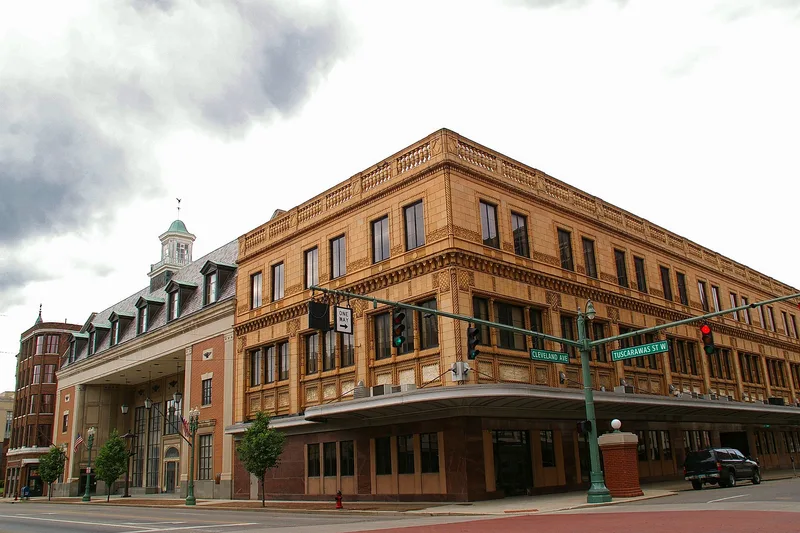
Upper Downtown Canton Historic District covers 34 blocks reaching north, east and west from Public Square in Canton, Ohio, anchored by Market Avenue and Cleveland Avenue. It counts 50 contributing buildings, 30 non-contributing buildings and one non-contributing object, along with nine buildings already individually listed, among them the Palace Theater, Stark County Courthouse, Onesto Hotel and Trinity Lutheran Church. Contributing buildings date from 1881 to 1955 and are mostly commercial in form, with Renaissance Revival, Romanesque Revival, Beaux-Arts Classical and Art Deco details. Two bank towers rise along Market Avenue: the George Harter Bank, with a twelve-story Sullivanesque tower, and the fourteen-story First National Bank. The district reflects the northward and southward growth of Canton's business center from the 1880s, supported by electric streetcars and by local steel and paving brick industries. The 1914 Renkert Building, faced with Metropolitan paving bricks, was the city's first skyscraper.
Machine-generated summary. This summary was generated by a language model from the official nomination document and has not been reviewed line by line by an editor. It may contain errors. Check the source document before relying on any detail. Source: nomination document (PDF) · catalog entry. Generated October 2026 (model claude-sonnet-5-5, prompt v1.0-2026-10-29).
| Styles | Late Victorian; Late 19th and Early 20th Century Revivals; Late 19th and Early 20th Century American Movements |
|---|---|
| Areas of significance | Commerce, Architecture |
| Acreage | 80 |
| Boundary source | NPS cultural-resource GIS polygon |
| Full listing page | Upper Downtown Canton Historic District (Additional Documentation) (property record) |
What listing means for this property
This is a historic district. Buildings within its boundary are either contributing (they add to the district's significance) or non-contributing. Owners of contributing income-producing buildings can claim the 20% federal rehabilitation tax credit; homeowners should look at state credits. National Register districts impose no design review by themselves; a local historic district ordinance, if one exists, does (the difference explained).
General information, not legal or tax advice. Rules change; confirm with your State Historic Preservation Office or a qualified adviser.