Ohio City Preservation District

Why it's listed
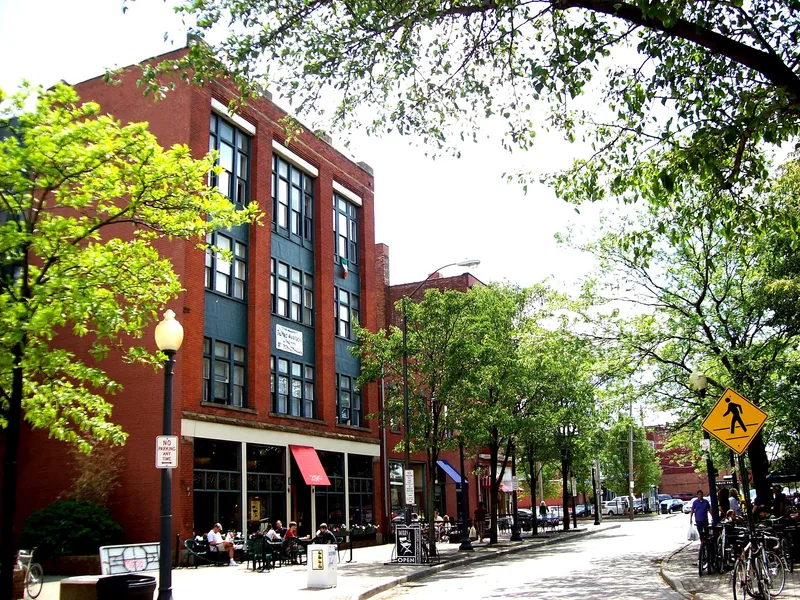
Ohio City Preservation District covers about 80 acres of Cleveland's near west side, in an area that was once the independent municipality of Ohio City. It takes in portions of twenty-five small blocks and includes roughly 250 houses, stores, a public library, two churches and several apartment buildings. Most houses are modest frame or brick homes built for brewery workers, carpenters and tradesmen, mixed with larger Italianate, Second Empire and Queen Anne residences of merchants and bankers. Landmarks include St. Patrick's Church, begun in 1871 and finished in 1913, the Franklin Circle Christian Church by Cudell and Richardson, and the Carnegie West Library of 1910, designed by Edward L. Tilton. The area was settled largely by Irish and German immigrants, and Ohio City merged with Cleveland in 1854. It was listed as a nearly complete nineteenth-century community and as the site of a private preservation movement that began in 1968. Some blocks are badly deteriorated, and one Italianate house was lost to fire in 1975.
Machine-generated summary. This summary was generated by a language model from the official nomination document and has not been reviewed line by line by an editor. It may contain errors. Check the source document before relying on any detail. Source: nomination document (PDF) · catalog entry. Generated October 2026 (model claude-sonnet-5-5, prompt v1.0-2026-10-29).
| Period of significance | 1836-1913 |
|---|---|
| Styles | Victorian Gothic, Italianate, Second Empire, Eastlake, Queen Anne, Gothic Revival and Beaux-Arts |
| Areas of significance | Architecture, Social History |
| Acreage | 80 |
| Boundary source | NPS cultural-resource GIS polygon |
| Full listing page | Ohio City Preservation District (property record) |
What listing means for this property
This is a historic district. Buildings within its boundary are either contributing (they add to the district's significance) or non-contributing. Owners of contributing income-producing buildings can claim the 20% federal rehabilitation tax credit; homeowners should look at state credits. National Register districts impose no design review by themselves; a local historic district ordinance, if one exists, does (the difference explained).
General information, not legal or tax advice. Rules change; confirm with your State Historic Preservation Office or a qualified adviser.