Ninth Street Historic District

Why it's listed
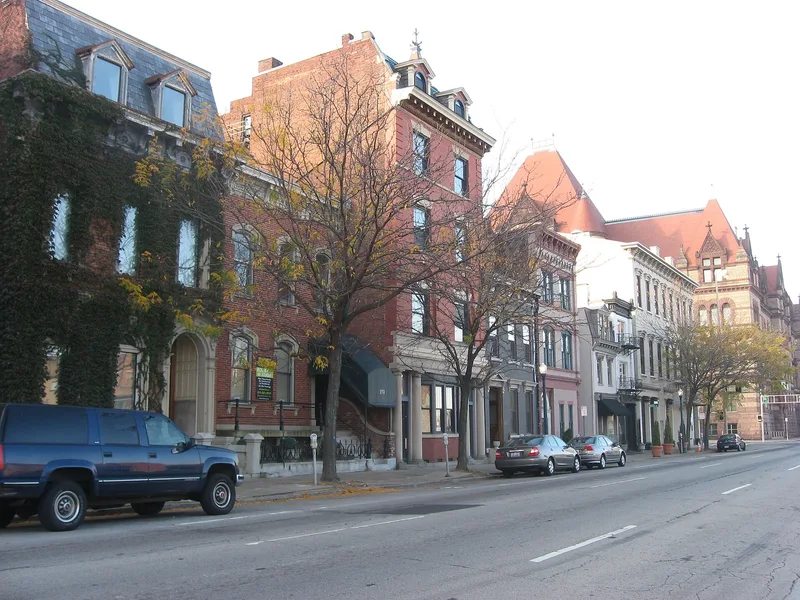
Ninth Street between Vine and Plum Streets, at the northwest edge of downtown Cincinnati, holds about fifty masonry buildings that together form a compact nineteenth-century streetscape. Most rise two to eight stories on narrow lots, typically three bays wide, and the oldest are three- and four-story townhouses sharing common walls, with brick carriage houses behind. Larger buildings anchor the corners and house the main commercial activity, while the middle of each block holds houses, rooming houses and small offices. The styles are varied, with Greek Revival, Italianate and Queen Anne most common. Key buildings include the Phoenix Club of 1893, the Brittany and Saxony apartment buildings of 1881, Trinity Methodist Episcopal Church of 1859, and the Elks Lodge of 1923 later used by the Crosley Corporation for broadcasting. Stone fronts, polychromatic brickwork and classical detailing give the group its character. Spot demolitions have broken the continuity in places, but the district remains one of the best surviving nineteenth-century blocks in the city centre.
Machine-generated summary. This summary was generated by a language model from the official nomination document and has not been reviewed line by line by an editor. It may contain errors. Check the source document before relying on any detail. Source: nomination document (PDF) · catalog entry. Generated October 2026 (model claude-sonnet-5-5, prompt v1.0-2026-10-29).
| Styles | Greek Revival, Italianate, Queen Anne, Gothic Revival, Renaissance Revival, Eclectic |
|---|---|
| Areas of significance | Architecture, Social History |
| Acreage | 9 |
| Boundary source | NPS cultural-resource GIS polygon |
| Full listing page | Ninth Street Historic District (property record) |
What listing means for this property
This is a historic district. Buildings within its boundary are either contributing (they add to the district's significance) or non-contributing. Owners of contributing income-producing buildings can claim the 20% federal rehabilitation tax credit; homeowners should look at state credits. National Register districts impose no design review by themselves; a local historic district ordinance, if one exists, does (the difference explained).
General information, not legal or tax advice. Rules change; confirm with your State Historic Preservation Office or a qualified adviser.