Lower Price Hill Historic District

Why it's listed
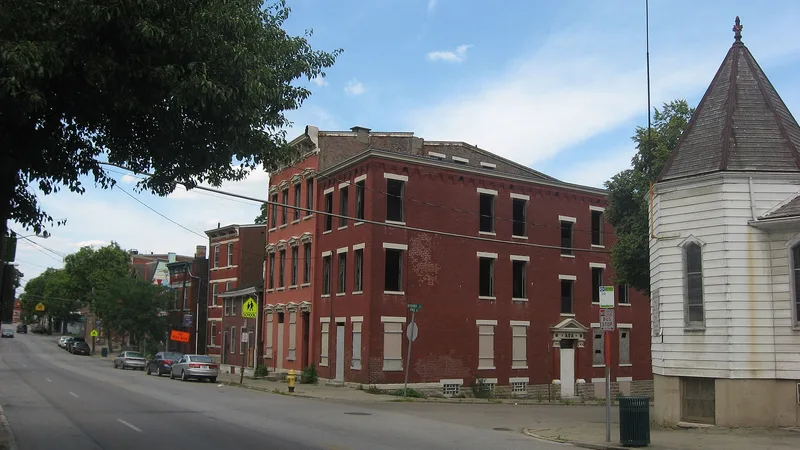
Lower Price Hill is a tightly packed Cincinnati neighborhood of roughly 25 acres at the eastern foot of Price Hill, beside the Mill Creek industrial valley. Its 206 buildings are mostly brick, and most were built to the sidewalk on long, narrow lots. Italianate multi-family houses dominate, with bracketed metal cornices and stone or metal window surrounds, reflecting the area's main growth in the 1870s and 1880s. Other building types add variety: corner commercial blocks with cast iron or stone storefronts, one-story brick rows, two churches, and two schools. Notable examples include the terra cotta Neo-Classical West End Bank Building, the Queen Anne and Colonial Revival Radel Funeral Home, and the 1930 Oyler School, designed by Samuel Hannaford & Sons and decorated with Rookwood tile. Industrial buildings along Burns Street show how factories and homes once stood side by side. The district was listed for this cohesive architecture and the intact streetscapes built mostly by 1938.
Machine-generated summary. This summary was generated by a language model from the official nomination document and has not been reviewed line by line by an editor. It may contain errors. Check the source document before relying on any detail. Source: nomination document (PDF) · catalog entry. Generated October 2026 (model claude-sonnet-5-5, prompt v1.0-2026-10-29).
| Period of significance | Begins with the first subdivision and construction of St. Michael's Church and ends in 1938 (exact start year not visible in the provided text) |
|---|---|
| Styles | Italianate, with Queen Anne, Classical Revival, Neo-Classical, Art Deco/Italian Romanesque, Gothic Revival and Art Moderne examples |
| Areas of significance | Architecture |
| Acreage | 25 |
| Boundary source | NPS cultural-resource GIS polygon |
| Full listing page | Lower Price Hill Historic District (property record) |
What listing means for this property
This is a historic district. Buildings within its boundary are either contributing (they add to the district's significance) or non-contributing. Owners of contributing income-producing buildings can claim the 20% federal rehabilitation tax credit; homeowners should look at state credits. National Register districts impose no design review by themselves; a local historic district ordinance, if one exists, does (the difference explained).
General information, not legal or tax advice. Rules change; confirm with your State Historic Preservation Office or a qualified adviser.