East Fourth Street Historic District

The National Park Service has not published a boundary polygon for this district; the map shows the listed properties inside it and the district's reference point.
Why it's listed
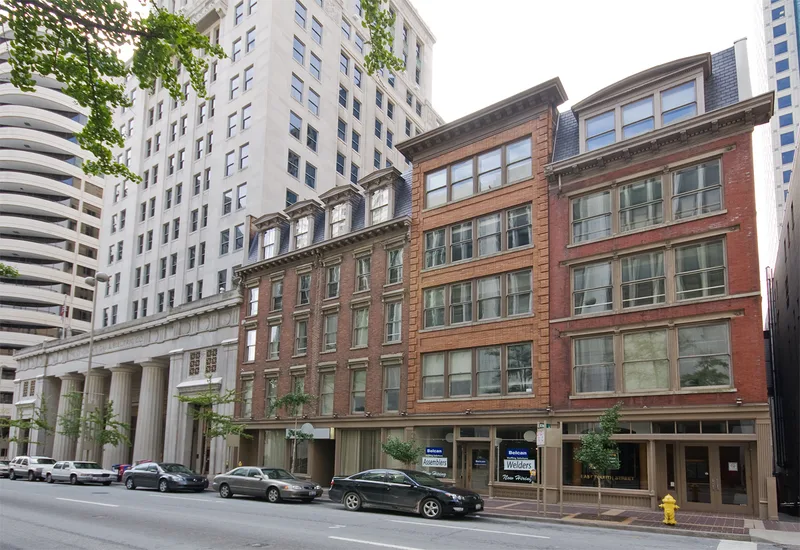
Three narrow, five-story brick commercial buildings stand together on the south side of East Fourth Street in downtown Cincinnati, at 123, 127 and 135-37. Built around 1860 as plain four-story Italianate structures, they later gained Mansard attic stories and other updates, so each now reflects a different phase of commercial style, including Second Empire, Commercial and Second Renaissance Revival features. Their matching scale, massing, materials and unified first-floor storefronts make them read as a cohesive group. They are among the few small-scale commercial buildings left from the era before 1900 to 1913, when bank and office towers remade the street into the city's financial center. The middle building was home to the John Holland Gold Pen Company from about 1860 to 1981, a maker of fine fountain pens sold worldwide. The Pounsford Stationery Company occupied 135-37 from 1876 to 1928. Rehabilitation work was restoring or sympathetically recreating the storefronts and cornices.
Machine-generated summary. This summary was generated by a language model from the official nomination document and has not been reviewed line by line by an editor. It may contain errors. Check the source document before relying on any detail. Source: nomination document (PDF) · catalog entry. Generated October 2026 (model claude-sonnet-5-5, prompt v1.0-2026-10-29).
| Period of significance | 1860-1900 |
|---|---|
| Styles | Second Empire, Second Renaissance Revival, Italianate |
| Areas of significance | Architecture |
| Acreage | 0.9 |
| Boundary source | not published |
| Full listing page | East Fourth Street Historic District (property record) |
What listing means for this property
This is a historic district. Buildings within its boundary are either contributing (they add to the district's significance) or non-contributing. Owners of contributing income-producing buildings can claim the 20% federal rehabilitation tax credit; homeowners should look at state credits. National Register districts impose no design review by themselves; a local historic district ordinance, if one exists, does (the difference explained).
General information, not legal or tax advice. Rules change; confirm with your State Historic Preservation Office or a qualified adviser.