Anderson Ferry

The National Park Service has not published a boundary polygon for this district; the map shows the listed properties inside it and the district's reference point.
Why it's listed
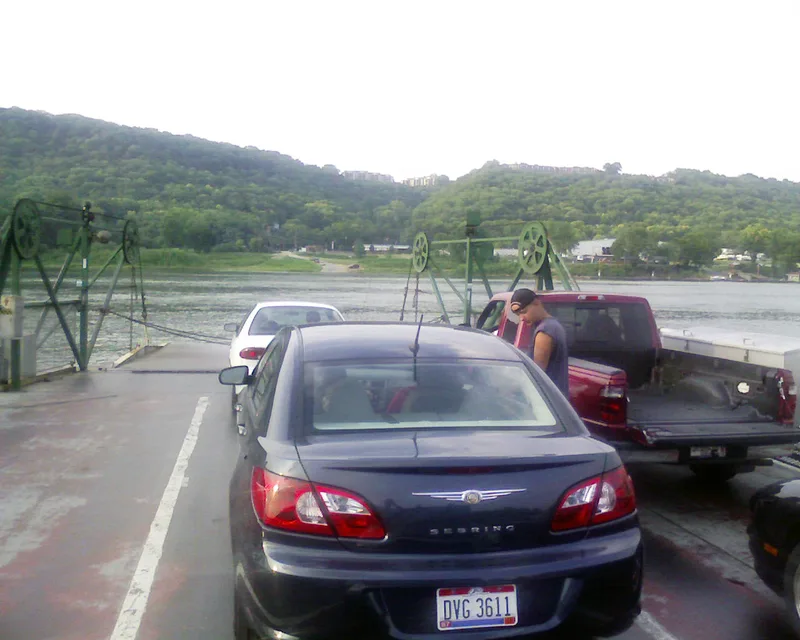
Anderson Ferry is a working river crossing on the Ohio River, linking western Cincinnati, Ohio, with Constance, Kentucky. The nominated district covers about 1.2 acres on the Ohio shore and 7.4 acres on the Kentucky shore, including a small farm complex of a house, a barn and outbuildings near the Kentucky landing. Two boats serve the crossing. Boone #7, built in 1937 of steel plate, is a double-ended diesel side-paddlewheel ferry. Little Boone, built in 1952, is a barge pushed by a work boat on a pivot hitch. George Anderson bought an existing ferry in 1817, and Charles Kottmyer purchased it in 1865; the Kottmyer family has operated it since, building several boats. The ferry predates the area's first permanent bridge and still provides a link between the two states. Review comments treated the 1937 boat as contributing, while the 1952 boat was considered too recent.
Machine-generated summary. This summary was generated by a language model from the official nomination document and has not been reviewed line by line by an editor. It may contain errors. Check the source document before relying on any detail. Source: nomination document (PDF) · catalog entry. Generated October 2026 (model claude-sonnet-5-5, prompt v1.0-2026-10-29).
| Period of significance | 1817 |
|---|---|
| Areas of significance | Transportation |
| Acreage | 8.6 |
| Boundary source | not published |
| Full listing page | Anderson Ferry (property record) |
What listing means for this property
This is a historic district. Buildings within its boundary are either contributing (they add to the district's significance) or non-contributing. Owners of contributing income-producing buildings can claim the 20% federal rehabilitation tax credit; homeowners should look at state credits. National Register districts impose no design review by themselves; a local historic district ordinance, if one exists, does (the difference explained).
General information, not legal or tax advice. Rules change; confirm with your State Historic Preservation Office or a qualified adviser.