Three Squares Historic District

Why it's listed
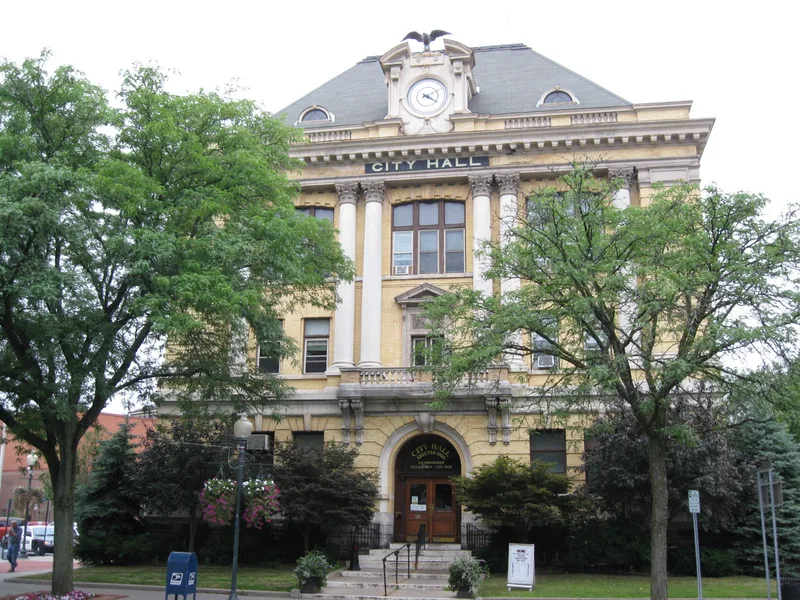
Three Squares Historic District covers 23 acres at the commercial heart of Glens Falls, New York, on a plateau above the Hudson River. It is organized around Glen Street and South Street and takes its name from three focal points: Fountain Square, Union Square and Monument Square. City Park, a landscaped one-block open space, lies near the center. The district holds 93 commercial and civic structures, 77 of which contribute to its character. Most are brick buildings of two to five stories, built mainly between 1902 and 1930 after devastating fires in 1864 and 1902 destroyed much of the earlier business district. Styles of the American Renaissance dominate, including Italianate, Romanesque, Queen Anne, Beaux-Arts, Neoclassical and Colonial Revival. Notable buildings include the Cowles block of 1865, the Rogers Building of 1926-27, the Beaux-Arts Saunders Building of 1907, the Empire Theatre of 1899 and City Hall of 1900. Urban renewal clearance in the 1960s removed part of the business district, but the remaining area keeps strong integrity of design and materials.
Machine-generated summary. This summary was generated by a language model from the official nomination document and has not been reviewed line by line by an editor. It may contain errors. Check the source document before relying on any detail. Source: nomination document (PDF) · catalog entry. Generated October 2026 (model claude-sonnet-5-5, prompt v1.0-2026-10-29).
| Styles | American Renaissance styles: Italianate, Romanesque, Queen Anne, Beaux-Arts, Neoclassical and Colonial Revival |
|---|---|
| Areas of significance | Commerce, Architecture |
| Acreage | 23 |
| Boundary source | NPS cultural-resource GIS polygon |
| Full listing page | Three Squares Historic District (property record) |
What listing means for this property
This is a historic district. Buildings within its boundary are either contributing (they add to the district's significance) or non-contributing. Owners of contributing income-producing buildings can claim the 20% federal rehabilitation tax credit; homeowners should look at state credits. National Register districts impose no design review by themselves; a local historic district ordinance, if one exists, does (the difference explained).
General information, not legal or tax advice. Rules change; confirm with your State Historic Preservation Office or a qualified adviser.