South Main Street Historic District

Why it's listed
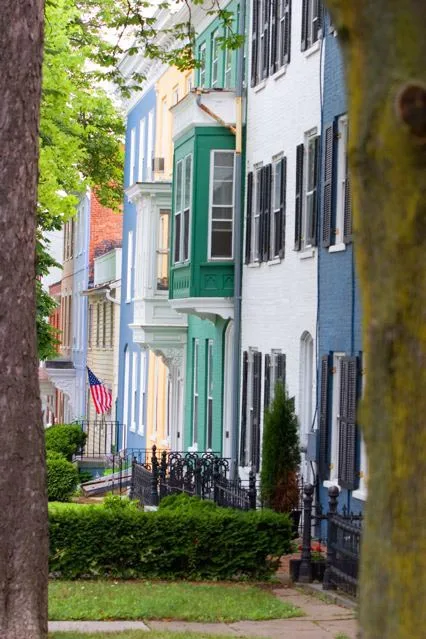
South Main Street in Geneva runs for about a mile along high ground above Seneca Lake's west bank. The historic district covers roughly 140 buildings, Pultney Park and the old quadrangle of Hobart College. Captain Charles Williamson, agent for the English Pultney Associates, is credited with laying out the street and park in the 1790s, and early lot terms kept the east side open to preserve the lake view. More than half the buildings date from 1825 to 1850, including brick rowhouses near the park and Greek Revival houses with porticos at the south end. Other styles range from Federal frame houses of 1802 and 1804 to Italianate, Gothic, Stick Style, Queen Anne, Tudor and Colonial Revival. Churches by Richard Upjohn and academic buildings by Clinton and Russell and Arthur Nash add variety. Railroad construction in the 1850s shifted commerce away, which kept the street residential. The Ladies Home Journal praised it in 1898. Hobart College and the Geneva Historical Society have helped preserve it.
Machine-generated summary. This summary was generated by a language model from the official nomination document and has not been reviewed line by line by an editor. It may contain errors. Check the source document before relying on any detail. Source: nomination document (PDF) · catalog entry. Generated October 2026 (model claude-sonnet-5-5, prompt v1.0-2026-10-29).
| Styles | Federal, Greek Revival, Italianate, Gothic, Stick Style, Romanesque, Queen Anne, Tudor, Jacobean and Colonial Revival |
|---|---|
| Areas of significance | Community Planning and Development, Education, Architecture |
| Acreage | 79 |
| Boundary source | NPS cultural-resource GIS polygon |
| Full listing page | South Main Street Historic District (property record) |
What listing means for this property
This is a historic district. Buildings within its boundary are either contributing (they add to the district's significance) or non-contributing. Owners of contributing income-producing buildings can claim the 20% federal rehabilitation tax credit; homeowners should look at state credits. National Register districts impose no design review by themselves; a local historic district ordinance, if one exists, does (the difference explained).
General information, not legal or tax advice. Rules change; confirm with your State Historic Preservation Office or a qualified adviser.