Park Place Historic District

Why it's listed
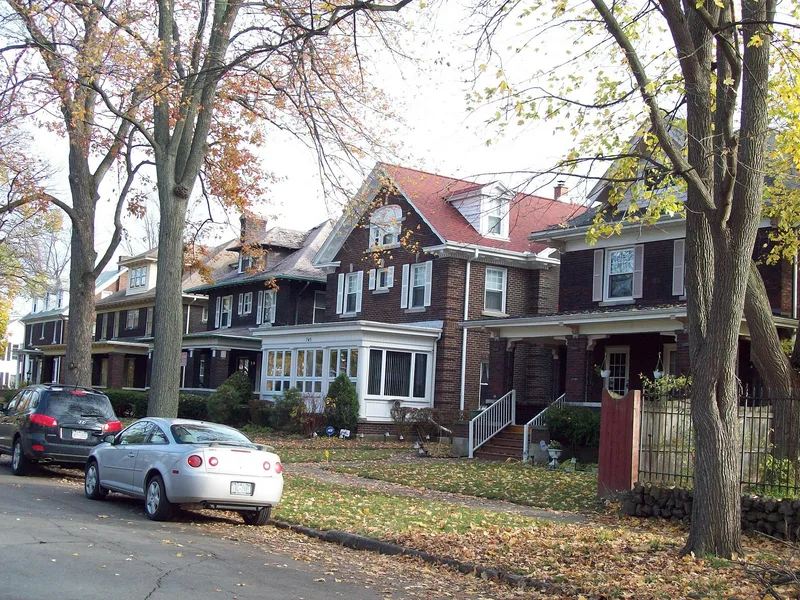
Park Place Historic District is a triangular residential neighborhood on the west side of Main Street in downtown Niagara Falls, New York. It includes Park Place, the 600 and 700 blocks of 4th Street, and parts of Pine Avenue and Main Street. Eighty-nine contributing buildings, mostly houses built between 1885 and 1928, stand alongside Wright Park, which holds veterans' memorials and a cenotaph obelisk, and a restored stone fence from the former Schoellkopf estate. The land was sold to Jacob Schoellkopf, whose hydraulic power company helped develop the area. Small lots on the 600 block of 4th Street held worker housing and travelers' homes. Larger lots on Park Place and the 700 block, protected by deed restrictions, held homes of the power company's executives and other industrial leaders. The houses show Queen Anne, Italianate, Arts and Crafts, Colonial Revival and Tudor Revival styles. Tree-lined streets and alley-served lots have kept the neighborhood's early residential character, unlike many nearby downtown areas that lost buildings to demolition.
Machine-generated summary. This summary was generated by a language model from the official nomination document and has not been reviewed line by line by an editor. It may contain errors. Check the source document before relying on any detail. Source: nomination document (PDF) · catalog entry. Generated October 2026 (model claude-sonnet-5-5, prompt v1.0-2026-10-29).
| Styles | Late Victorian (Italianate, Queen Anne); Late 19th & 20th Century Colonial Revival and Craftsman |
|---|---|
| Areas of significance | Architecture |
| Acreage | 17.1 |
| Boundary source | NPS cultural-resource GIS polygon |
| Full listing page | Park Place Historic District (property record) |
What listing means for this property
This is a historic district. Buildings within its boundary are either contributing (they add to the district's significance) or non-contributing. Owners of contributing income-producing buildings can claim the 20% federal rehabilitation tax credit; homeowners should look at state credits. National Register districts impose no design review by themselves; a local historic district ordinance, if one exists, does (the difference explained).
General information, not legal or tax advice. Rules change; confirm with your State Historic Preservation Office or a qualified adviser.