Deveaux School Historic District

The National Park Service has not published a boundary polygon for this district; the map shows the listed properties inside it and the district's reference point.
Why it's listed
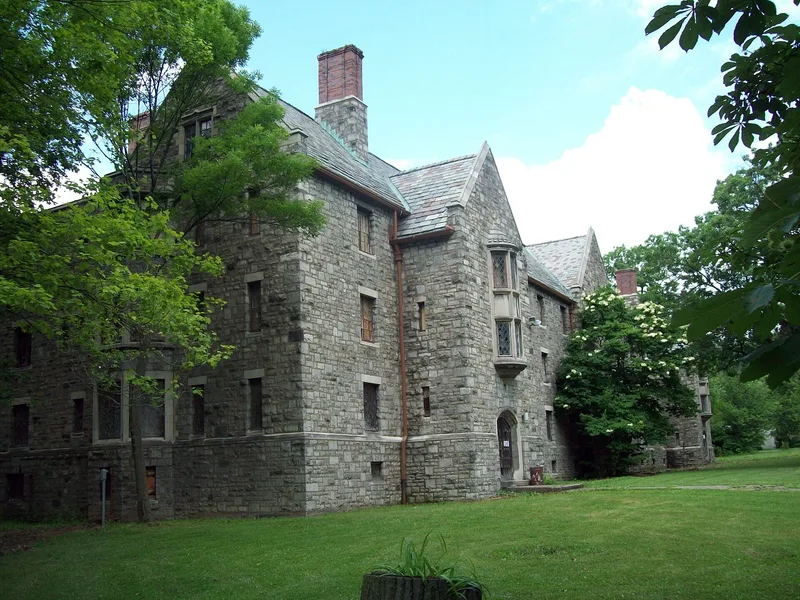
Set above the Great Whirlpool at the north end of Niagara Falls, this six-acre campus grew from a charitable school founded and endowed by Judge Samuel DeVeaux for orphaned and destitute boys. Its centerpiece is the stone Van Rensselaer-Munro Hall, begun in 1855 to designs by Buffalo architect C. H. Otis and enlarged in 1866 and 1888, when Munro Hall added a larger chapel with a crenellated bell tower. Three other nineteenth-century structures survive: an 1863 brick barn, an 1870 gymnasium with an unusual barrel-vaulted interior, and the 1890s chaplain's house called Edgewood. Run by the Episcopal Diocese of Western New York, the school modeled itself on New England boarding schools, and a long dispute over admitting fee-paying students ended in 1910. It later served as a boys' preparatory school, closed in 1971, and reopened a year later for children with learning disabilities. The grounds remain one of the city's notable open spaces.
Machine-generated summary. This summary was generated by a language model from the official nomination document and has not been reviewed line by line by an editor. It may contain errors. Check the source document before relying on any detail. Source: nomination document (PDF) · catalog entry. Generated October 2026 (model claude-sonnet-5-5, prompt v1.0-2026-10-29).
| Styles | Gothic-inspired (Munro Hall described as elegant gothic-inspired stone structure) |
|---|---|
| Areas of significance | Education, Religion, Social History |
| Acreage | 6 |
| Boundary source | not published |
| Full listing page | Deveaux School Historic District (property record) |
What listing means for this property
This is a historic district. Buildings within its boundary are either contributing (they add to the district's significance) or non-contributing. Owners of contributing income-producing buildings can claim the 20% federal rehabilitation tax credit; homeowners should look at state credits. National Register districts impose no design review by themselves; a local historic district ordinance, if one exists, does (the difference explained).
General information, not legal or tax advice. Rules change; confirm with your State Historic Preservation Office or a qualified adviser.