Chestertown Historic District (Additional Documentation)

Why it's listed
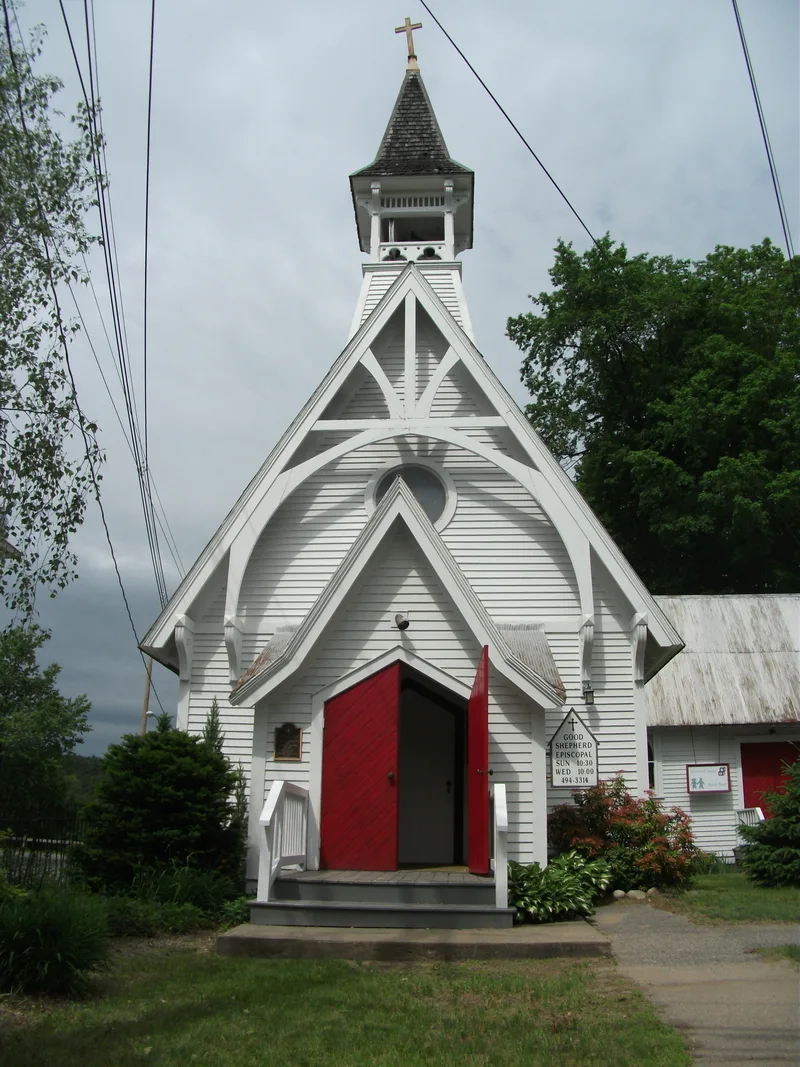
Chestertown's historic district is a compact group of three buildings facing U.S. Route 9 in the center of the village, in northern Warren County. The Fowler Homestead is a rambling wood farmhouse built in stages, with a small section reputed to be the oldest and a prominent Greek Revival portion probably added in the 1840s by Charles Fowler. Barns, sheds, a family cemetery and a 1913 centennial monument are also within the boundaries. Beside it stands the Church of the Good Shepherd, a small wood mission church built in 1883 at a cost of $2,500 by the Albany Episcopal Diocese, with a steep roof, bell tower and stick style gable decoration. The third building, now the Chester Town Hall and a museum, was constructed in 1913 as a high school and later served as a factory and antique shop. Together they show how plain wood detailing gave the village a consistent character across several periods.
Machine-generated summary. This summary was generated by a language model from the official nomination document and has not been reviewed line by line by an editor. It may contain errors. Check the source document before relying on any detail. Source: nomination document (PDF) · catalog entry. Generated October 2026 (model claude-sonnet-5-5, prompt v1.0-2026-10-29).
| Styles | Greek Revival farmhouse; rural vernacular parish church revival (Stick style detail); vernacular school building |
|---|---|
| Areas of significance | Exploration/Settlement, Architecture, Religion, Entertainment/Recreation, Community Planning and Development |
| Acreage | 2.5 |
| Boundary source | NPS cultural-resource GIS polygon |
| Full listing page | Chestertown Historic District (Additional Documentation) (property record) |
What listing means for this property
This is a historic district. Buildings within its boundary are either contributing (they add to the district's significance) or non-contributing. Owners of contributing income-producing buildings can claim the 20% federal rehabilitation tax credit; homeowners should look at state credits. National Register districts impose no design review by themselves; a local historic district ordinance, if one exists, does (the difference explained).
General information, not legal or tax advice. Rules change; confirm with your State Historic Preservation Office or a qualified adviser.