New Bedford Gas and Edison Light Complex

Why it's listed
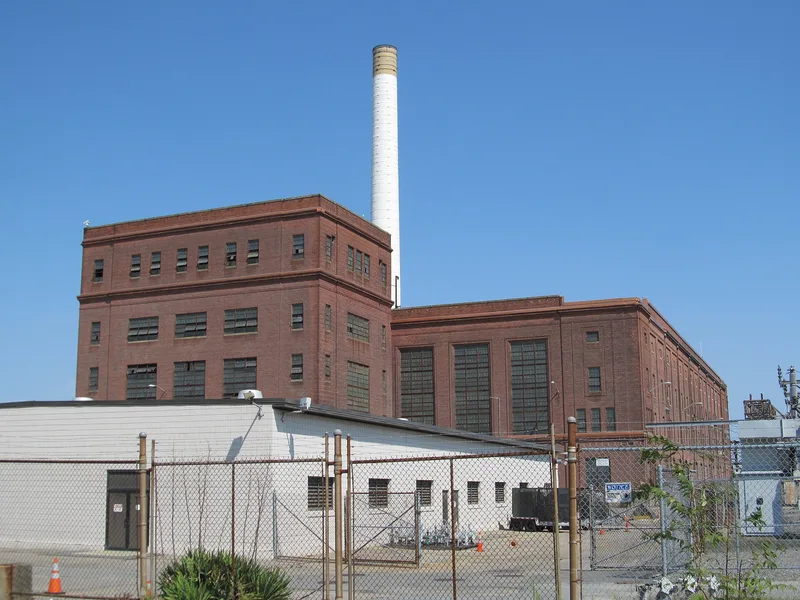
Located on the Acushnet River waterfront in New Bedford, this 5.8-acre industrial complex grew around the Cannon Street Power Station, built in 1916 by Stone & Webster Engineering Corporation for the New Bedford Gas & Edison Light Company. The red-brick station, expanded several times through 1950, has a 390-foot turbine hall and a skylit roof monitor. Nearby stands the Taber & Grinnell Iron Foundry of 1856, a three-story granite building with Greek Revival influence, along with Eddy's Wharf, a filled wharf with a granite seawall, and a 1940s filtering station. By 1950 the plant supplied electricity to New Bedford, neighboring towns and nearly all of Cape Cod, Martha's Vineyard and the Plymouth area. It operated until 1992, when it was closed and stripped of much of its machinery. The district was listed for its role in regional power generation and for its industrial architecture, and a new use as an Oceanarium was planned.
Machine-generated summary. This summary was generated by a language model from the official nomination document and has not been reviewed line by line by an editor. It may contain errors. Check the source document before relying on any detail. Source: nomination document (PDF) · catalog entry. Generated October 2026 (model claude-sonnet-5-5, prompt v1.0-2026-10-29).
| Styles | Classical Revival / Art Moderne |
|---|---|
| Areas of significance | Engineering, Industry, Architecture |
| Acreage | 5.8 |
| Boundary source | NPS cultural-resource GIS polygon |
| Full listing page | New Bedford Gas and Edison Light Complex (property record) |
What listing means for this property
This is a historic district. Buildings within its boundary are either contributing (they add to the district's significance) or non-contributing. Owners of contributing income-producing buildings can claim the 20% federal rehabilitation tax credit; homeowners should look at state credits. National Register districts impose no design review by themselves; a local historic district ordinance, if one exists, does (the difference explained).
Noted as vacant in the nomination. Nomination documents can be decades old; current status may differ. If you are considering buying an empty listed property, read the due-diligence checklist.
General information, not legal or tax advice. Rules change; confirm with your State Historic Preservation Office or a qualified adviser.