Falmouth Village Green Historic District

Why it's listed
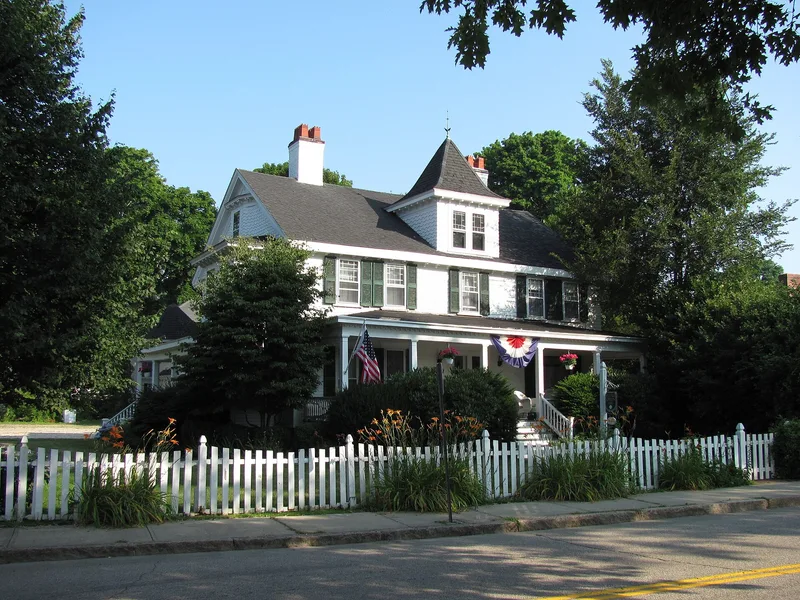
Falmouth Village Green Historic District covers the old center of Falmouth on Cape Cod, Massachusetts. It is organized around a one-acre Town Common and the nearby Old Burying Ground, with houses, churches and shops lining Main, North Main, Palmer, Locust and Hewins Streets. Most buildings are two to two and a half stories, clad in shingle or clapboard, and date from the late 18th to mid 19th centuries. The oldest house, the Conant (Palmer) House, dates to about 1730. Styles run from Georgian and Federal to Queen Anne, Shingle Style and Colonial Revival. The district reflects the town's changing economy: maritime trade and saltmaking declined by 1870, and the railroad's arrival in 1872 brought summer residents. Their influence appears in St. Barnabas Church of 1890, designed by Henry Vaughan, with grounds by Frederick Law Olmsted, and in the 1926 Queens Buyway shops. Many buildings remain in good condition with periodic restoration.
Machine-generated summary. This summary was generated by a language model from the official nomination document and has not been reviewed line by line by an editor. It may contain errors. Check the source document before relying on any detail. Source: nomination document (PDF) · catalog entry. Generated October 2026 (model claude-sonnet-5-5, prompt v1.0-2026-10-29).
| Styles | Georgian, Federal, Greek Revival, Gothic Revival, Italianate, Second Empire, Queen Anne, Shingle Style, Colonial Revival, Classical Revival |
|---|---|
| Areas of significance | Architecture, Community Planning and Development, Exploration/Settlement, Landscape Architecture, Social History |
| Acreage | 38.1 |
| Boundary source | NPS cultural-resource GIS polygon |
| Full listing page | Falmouth Village Green Historic District (property record) |
What listing means for this property
This is a historic district. Buildings within its boundary are either contributing (they add to the district's significance) or non-contributing. Owners of contributing income-producing buildings can claim the 20% federal rehabilitation tax credit; homeowners should look at state credits. National Register districts impose no design review by themselves; a local historic district ordinance, if one exists, does (the difference explained).
General information, not legal or tax advice. Rules change; confirm with your State Historic Preservation Office or a qualified adviser.