Beverly Center Business District

Why it's listed
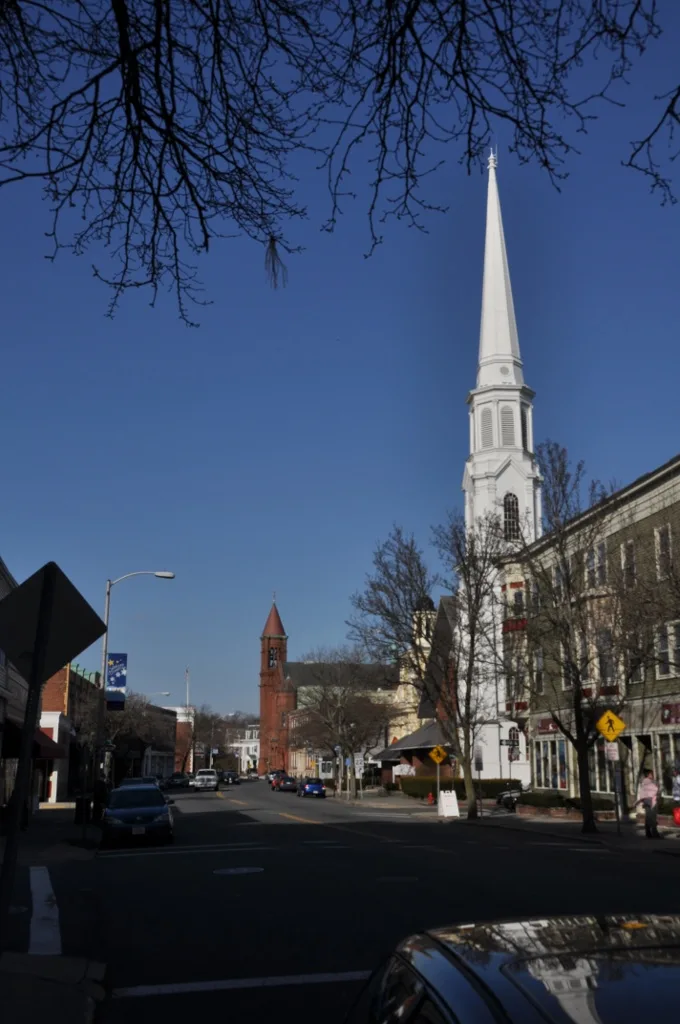
Beverly's central business district occupies about 46 acres on a level point of land between the Bass River and Beverly Harbor. Cabot Street forms its spine, with sixteen side streets holding 105 properties, among them 88 contributing structures, a monument, a burial ground and the Common. Buildings range from the 1770 First Parish Church, remodeled in Greek Revival form in 1835, to the 1913 Public Library designed by Cass Gilbert. Federal mansions built for merchants John and Andrew Cabot, Victorian commercial blocks, churches, a school and Colonial Revival houses around Monument Square show how the area changed over time. The district grew most strongly in the late 19th and early 20th centuries, when the railroad arrived in 1839 and a successful shoe industry emerged, moving the town's focus from the waterfront to Cabot Street. It reflects Beverly's evolution from a maritime and agricultural town into a small industrial city, and it holds possible archaeological potential.
Machine-generated summary. This summary was generated by a language model from the official nomination document and has not been reviewed line by line by an editor. It may contain errors. Check the source document before relying on any detail. Source: nomination document (PDF) · catalog entry. Generated October 2026 (model claude-sonnet-5-5, prompt v1.0-2026-10-29).
| Period of significance | 1764-1934 |
|---|---|
| Styles | Range of styles from Georgian, Federal and Greek Revival to Victorian Gothic, Queen Anne, Romanesque Revival, Colonial Revival and Classical Revival |
| Areas of significance | Commerce, Architecture |
| Acreage | 45.7 |
| Boundary source | NPS cultural-resource GIS polygon |
| Full listing page | Beverly Center Business District (property record) |
What listing means for this property
This is a historic district. Buildings within its boundary are either contributing (they add to the district's significance) or non-contributing. Owners of contributing income-producing buildings can claim the 20% federal rehabilitation tax credit; homeowners should look at state credits. National Register districts impose no design review by themselves; a local historic district ordinance, if one exists, does (the difference explained).
General information, not legal or tax advice. Rules change; confirm with your State Historic Preservation Office or a qualified adviser.