Gaslamp Quarter Historic District

Why it's listed
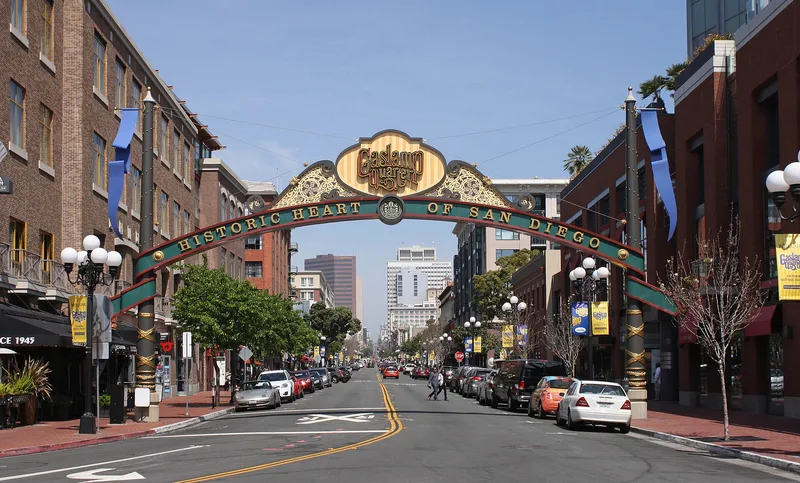
Sixteen blocks of downtown San Diego, bounded by Broadway, 4th Avenue, Pacific Highway and 6th Avenue, make up the Gaslamp Quarter, formerly called the "Stingaree." Most buildings date from 1880 to 1910. They are typically two and three stories of common brick, built at the property line with tall ground floors, corbelled cornices, deep-set openings, inset entrances and bay windows. Notable examples include the Louis Bank of Commerce, Nesmith-Greely, Hubbell, Marston, Keating and Backesto buildings. Many facades were later stripped, stuccoed or covered with metal fronts, though some blocks remain largely intact. The district was nominated as the only significant remnant of turn-of-the-century commercial San Diego. Alonzo Horton's land purchases and wharf at the foot of Fifth Avenue encouraged investment, and by 1900 Fifth Avenue was the city's commercial hub, with electric streetcars and arc lamps. The nomination argues that the flavor of that first urban period is worth preserving.
Machine-generated summary. This summary was generated by a language model from the official nomination document and has not been reviewed line by line by an editor. It may contain errors. Check the source document before relying on any detail. Source: nomination document (PDF) · catalog entry. Generated October 2026 (model claude-sonnet-5-5, prompt v1.0-2026-10-29).
| Period of significance | 1900-1999 |
|---|---|
| Styles | Mainly Victorian-era commercial brick architecture, including Romanesque Revival and Baroque Revival or Second Empire buildings, with some Art Deco, Art Nouveau and Mission/Spanish Revival examples |
| Areas of significance | Industry, Community Planning and Development, Commerce, Politics/Government, Architecture |
| Acreage | 38 |
| Boundary source | NPS cultural-resource GIS polygon |
| Full listing page | Gaslamp Quarter Historic District (property record) |
What listing means for this property
This is a historic district. Buildings within its boundary are either contributing (they add to the district's significance) or non-contributing. Owners of contributing income-producing buildings can claim the 20% federal rehabilitation tax credit; homeowners should look at state credits. National Register districts impose no design review by themselves; a local historic district ordinance, if one exists, does (the difference explained).
General information, not legal or tax advice. Rules change; confirm with your State Historic Preservation Office or a qualified adviser.