Berkeley High School Campus Historic District

Why it's listed
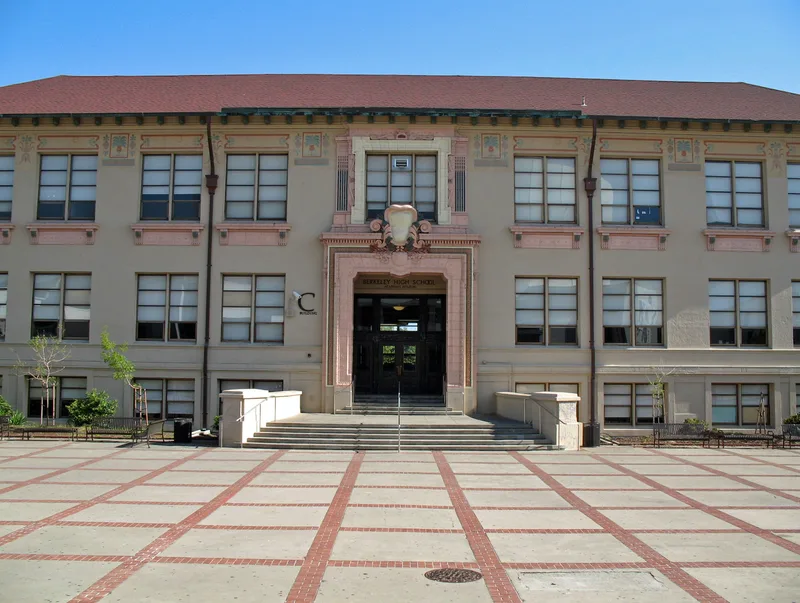
Berkeley High School's campus occupies four downtown city blocks, roughly 12.5 acres, bounded by Martin Luther King Jr. Way, Allston Way, Milvia Street and Channing Way. The district has eight buildings, five of them contributing. Its centerpiece is the 1922 Academic Building by William C. Hays, a Beaux Arts and Italianate design with glazed polychrome terra cotta details. Hays also designed the original gymnasium and natatorium, which was later remade in a Streamlined Moderne style after the 1933 Field Act called for seismic upgrades. Art Deco additions followed, including the Shop Building (1939), the Science Building (1940) and the Community Theater, designed by Gutterson and Corlett and finished in 1950 with sculpted reliefs by Robert Howard. The campus is described as an early example of a plan with function-specific buildings, and its structures have kept their original locations and key character-defining features despite seismic retrofits and window replacements. The period of significance runs from 1922 to 1950.
Machine-generated summary. This summary was generated by a language model from the official nomination document and has not been reviewed line by line by an editor. It may contain errors. Check the source document before relying on any detail. Source: nomination document (PDF) · catalog entry. Generated October 2026 (model claude-sonnet-5-5, prompt v1.0-2026-10-29).
| Period of significance | 1922-1950 |
|---|---|
| Styles | 20th Century Revivals - Beaux Arts & Beaux Arts Classicism; Moderne Movement - Streamlined Moderne & Art Deco |
| Areas of significance | Architecture |
| Acreage | 12.5 |
| Boundary source | NPS cultural-resource GIS polygon |
| Full listing page | Berkeley High School Campus Historic District (property record) |
What listing means for this property
This is a historic district. Buildings within its boundary are either contributing (they add to the district's significance) or non-contributing. Owners of contributing income-producing buildings can claim the 20% federal rehabilitation tax credit; homeowners should look at state credits. National Register districts impose no design review by themselves; a local historic district ordinance, if one exists, does (the difference explained).
General information, not legal or tax advice. Rules change; confirm with your State Historic Preservation Office or a qualified adviser.