Bok Kai Temple

Why it's listed
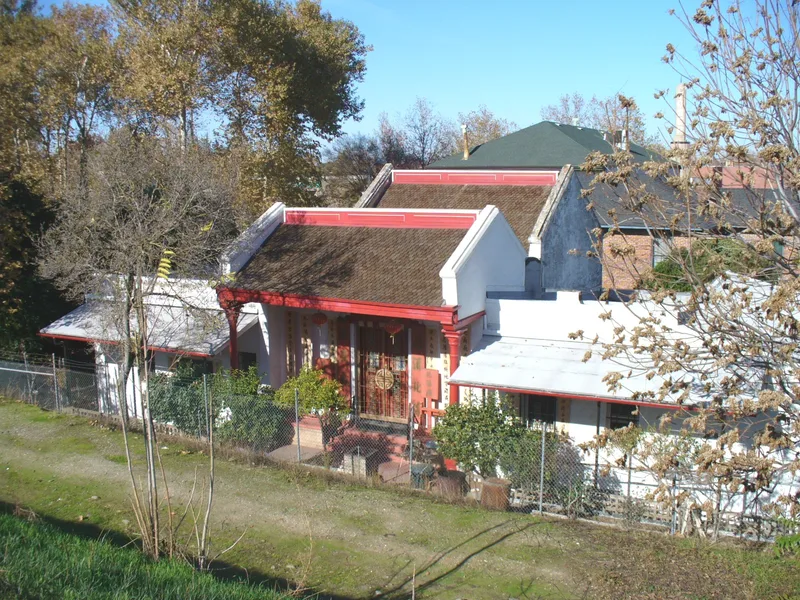
Bok Kai Temple, on the Yuba River levee at D Street in Marysville, California, is a Chinese temple dedicated in March 1880. Its sanctuary has plastered brick walls, a mission tile roof, a tiled porch on turned wood columns, carved wood trim and a hand-painted scene above the entry. Side rooms flank the sanctuary, and a wood-frame kitchen and dwelling room was added at the northeast corner. It replaced a first temple of 1854 built about two blocks upstream. The temple honors Bok Eye, the Water God believed to control floods, rains and irrigation waters, alongside other deities. It is described as the only temple in the United States devoted to him. It stands in what remains one of the oldest Chinatowns in the country, once a rest and supply center for miners and laborers. Each year the Bomb Day festival, held since 1880 with interruptions, draws thousands of visitors. The community began restoring the building in 1947.
Significance in brief: The nomination states it is the only temple in the United States honoring Bok Eye, the Chinese Water God. It anchors the surviving Marysville Chinatown and hosts the annual Bomb Day festival, which is described as one of the oldest public Chinese festivals in America. It preserves Chinese American religious traditions from the late 19th century.
Machine-generated summary. This summary was generated by a language model from the official nomination document and has not been reviewed line by line by an editor. It may contain errors. Check the source document before relying on any detail. Source: nomination document (PDF) · National Archives catalog entry. NRHP reference 75000498, listed May 21, 1975. Summary generated October 2026 (model claude-sonnet-5-5, prompt v1.0-2026-10-29, confidence medium).
Key facts
| Address | Yuba River Levee at D St., Marysville |
|---|---|
| County | Yuba County |
| Listed | May 21, 1975 |
| Reference number | 75000498 |
| Resource type | Building |
| Architect / builder | Built by a handful of faithful members of the Chinese community; no architect named |
| Areas of significance | Architecture, Religion |
| Level of significance | State |
| Status (as stated in the nomination) | Condition marked fair and altered; in regular use by the local Chinese community as a temple and open to visitors on request. Restoration work began in 1947 and stabilization work was later planned. |
| Acreage | 0.1 |
| Coordinates | 39.13489, -121.58803 (NPS GIS) |
What listing means for this property
Religious properties are listed for their architectural or historical significance, not their religious use. Listing is honorary and does not restrict the congregation's use of the building. The federal rehabilitation credit is generally unavailable unless part of the building is income-producing; some state programmes and preservation grants do cover religious buildings. Federal funding or permits trigger Section 106 review.
General information, not legal or tax advice. Rules change; confirm with your State Historic Preservation Office or a qualified adviser.
Sources and further reading
- National Park Service, National Register of Historic Places database (snapshot May 2026), reference 75000498.
- Nomination form (PDF, National Archives) — catalog entry
- Wikipedia article (used for cross-checking only; text not reproduced here)
- Wikidata Q4938700
- This listing as JSON
Last updated October 2026. Found an error? See the editorial policy for how to report it.