Woodland Opera House
Also known as: Hershey Opera House

Why it's listed
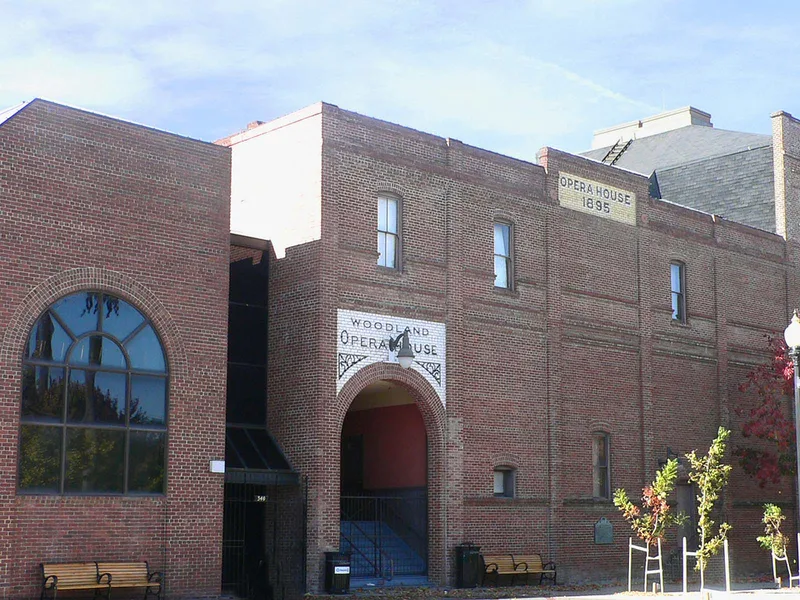
Woodland's Opera House, at 320 Second Street, is a two-story red brick theatre built in 1895-96 to replace an earlier opera house on the same site that opened in 1885 and burned in 1892. The new building runs 104 feet along Second Street and incorporates the east and west walls of its predecessor. Its facade is divided into seven sections by quasi-buttresses and is almost without decoration. Inside, a 25-foot-deep stage, a horseshoe balcony and a dress circle gave a total capacity of 644, a high figure for the town's population at the time. The stage house burned in 1937. David Newcomer Hershey, a California pioneer, an agricultural landowner and a state assemblyman, financed construction with support from a syndicate of local citizens. It is listed as one of four 19th-century California buildings designed as theatres and still intact for that use. More than 120 original painted scenes survive, held by the University of California, Davis.
Significance in brief: The nomination calls it a remarkable theatre that reflected local pride in the community's culture. It is described as one of four 19th-century California buildings designed as theatres and still intact for that use. Over 120 pieces of its original hand-painted scenery, including the drop curtain and a Rocky Mountain panorama, survive in good condition.
Machine-generated summary. This summary was generated by a language model from the official nomination document and has not been reviewed line by line by an editor. It may contain errors. Check the source document before relying on any detail. Source: nomination document (PDF) · National Archives catalog entry. NRHP reference 71000212, listed November 5, 1971. Summary generated October 2026 (model claude-sonnet-5-5, prompt v1.0-2026-10-29, confidence medium).
Key facts
| Address | 320 2nd St., Woodland |
|---|---|
| County | Yolo County |
| Listed | November 5, 1971 |
| Reference number | 71000212 |
| Resource type | Building |
| Period of significance | 1895-96 |
| Architectural style | Not adhering to any clearly definable architectural style (form notes a link to the adjoining Richardsonian-Romanesque Elliot building) |
| Areas of significance | Entertainment/Recreation, Architecture, Social History |
| Level of significance | Local |
| Status (as stated in the nomination) | Condition listed as fair and altered; the stage house burned in 1937. The form checks the property as unoccupied and advocates restoration as an operating theatre. |
| Acreage | 0.5 |
| Within district | Downtown Woodland Historic District |
| Coordinates | 38.67777, -121.77192 (NPS GIS) |
What listing means for this property
National Register listing is honorary for a privately owned home: it does not by itself restrict what an owner may do with their own money, and it does not require public access. Restrictions come from local landmark or historic-district ordinances, which are separate (how they differ).
Owner-occupied houses are not eligible for the 20% federal rehabilitation tax credit, which applies to income-producing buildings, but many states offer credits for homeowners. Listing also opens the door to preservation easements and to buying a plaque. Start with what listing means for homeowners, renovating a listed house and selling one.
Noted as vacant in the nomination. Nomination documents can be decades old; current status may differ. If you are considering buying an empty listed property, read the due-diligence checklist.
General information, not legal or tax advice. Rules change; confirm with your State Historic Preservation Office or a qualified adviser.
Sources and further reading
- National Park Service, National Register of Historic Places database (snapshot May 2026), reference 71000212.
- Nomination form (PDF, National Archives) — catalog entry
- Wikipedia article (used for cross-checking only; text not reproduced here)
- Wikidata Q2593174
- This listing as JSON
Last updated October 2026. Found an error? See the editorial policy for how to report it.