Downtown Woodland Historic District

Why it's listed
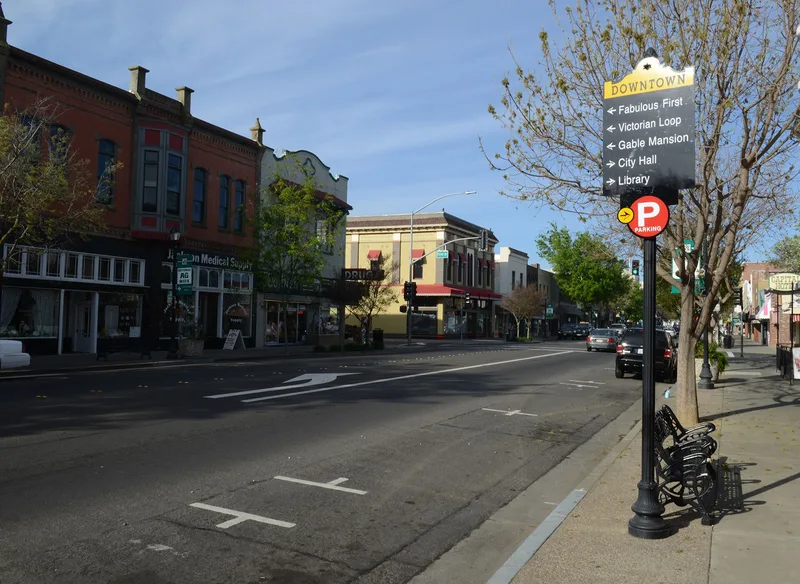
Woodland's downtown historic district covers Main Street, First Street and nearby blocks in Yolo County, California. It holds 59 contributing buildings and 34 noncontributing ones, most of them brick, with many covered in stucco. Main Street forms the spine, and about 80 percent of the buildings have ground-floor storefronts, often with offices above. Styles range from Italianate and Richardsonian Romanesque to Mission Revival, Spanish Colonial Revival, Mediterranean Revival and Streamline Moderne. Notable buildings include the 1917 county courthouse, the 1936 post office and city hall, the 1906 public library, the 1905 Oddfellows hall, the 1913 Porter Building, the 1928 Hotel Woodland and the 1896 opera house. Many Main Street buildings have altered storefronts, but upper floors often keep historic detail. The district was listed for its connection to commerce, government and social life between 1866 and 1948, and for retaining the scale, materials and sidewalk-facing character of a traditional downtown.
Significance in brief: The district is argued to be significant under Criterion A for its role in the commerce, politics/government and social history of Woodland between 1866 and 1948. It keeps the look and function of a traditional downtown, with contiguous brick buildings at the sidewalk, retail on Main Street, and major civic and social buildings. Its integrity is described as high.
Machine-generated summary. This summary was generated by a language model from the official nomination document and has not been reviewed line by line by an editor. It may contain errors. Check the source document before relying on any detail. Source: nomination document (PDF) · National Archives catalog entry. NRHP reference 99000471, listed June 22, 1999. Summary generated October 2026 (model claude-sonnet-5-5, prompt v1.0-2026-10-29, confidence medium).
Key facts
| Address | Roughly along Main St. from Elm St. to Third St., Woodland |
|---|---|
| County | Yolo County |
| Listed | June 22, 1999 |
| Reference number | 99000471 |
| Resource type | District |
| Period of significance | 1866-1948 |
| Architect / builder | Weeks, William H. |
| Architectural style | Mission/Spanish Colonial Revival, Classical Revival, Italianate |
| Criteria |
|
| Areas of significance | Commerce, Politics/Government, Social History |
| Level of significance | Local |
| Status (as stated in the nomination) | Retail remains the main use; the form says only a few buildings or storefronts are vacant, and some buildings have been converted to new uses. |
| Acreage | 37 |
| Coordinates | 38.67771, -121.77360 (NPS GIS) |
What listing means for this property
This is a historic district. Buildings within its boundary are either contributing (they add to the district's significance) or non-contributing. Owners of contributing income-producing buildings can claim the 20% federal rehabilitation tax credit; homeowners should look at state credits. National Register districts impose no design review by themselves; a local historic district ordinance, if one exists, does (the difference explained).
General information, not legal or tax advice. Rules change; confirm with your State Historic Preservation Office or a qualified adviser.
Sources and further reading
- National Park Service, National Register of Historic Places database (snapshot May 2026), reference 99000471.
- Nomination form (PDF, National Archives) — catalog entry
- Wikipedia article (used for cross-checking only; text not reproduced here)
- Wikidata Q5303615
- This listing as JSON
Last updated October 2026. Found an error? See the editorial policy for how to report it.